
n8n vs Zapier: 7 Essential Factors for Business Automation
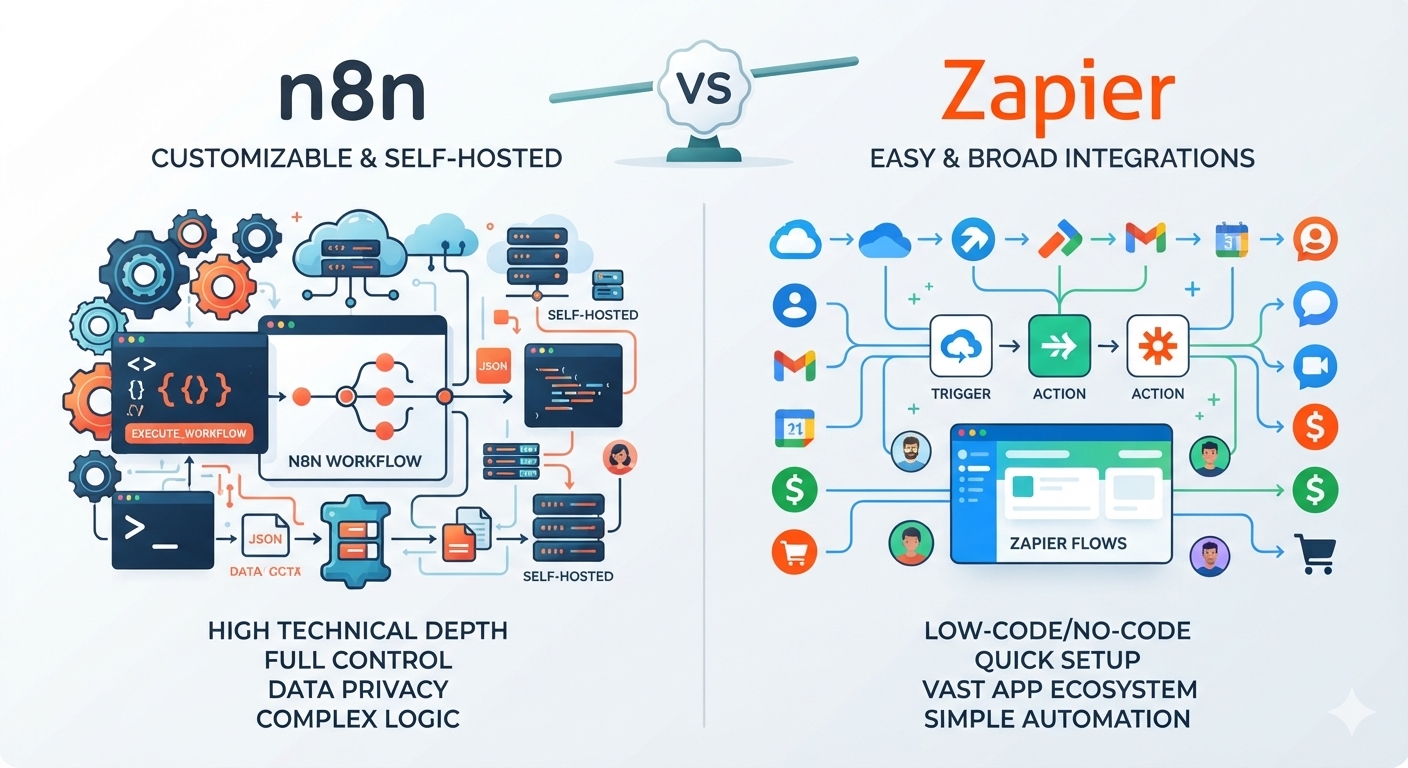
In today’s fast-paced business world, automation is no longer a luxury but a necessity. Streamlining repetitive tasks and integrating disparate systems can unlock significant efficiency, reduce errors, and free up valuable human resources for strategic initiatives. When evaluating workflow automation tools, two prominent platforms often come up: n8n and Zapier. While both aim to simplify and automate, they cater to different needs, technical proficiencies, and scale requirements.

At Applizor Softech LLP, we understand the critical role automation plays in digital transformation. From custom ERP and SaaS solutions to advanced AI agents and robust cloud infrastructure, our expertise spans the spectrum of modern business technology. This comprehensive comparison will delve into 7 essential factors to help startup founders, SME owners, and technical leaders make an informed decision between n8n and Zapier, ensuring you choose the best automation tool for complex workflows and high-volume operations.
Factor 1: Pricing Model and Cost-Effectiveness for Scale
One of the most significant differentiators between n8n and Zapier lies in their pricing structures, which directly impact cost-effectiveness, especially for high-volume or complex workflows.
- Zapier’s Task-Based Pricing: Zapier operates on a task-based model. Each action performed within a "Zap" (Zapier’s term for an automated workflow) counts as a task. For instance, triggering a workflow, sending an email, or updating a database record might each count as a task. While this model is straightforward for simple, low-volume automations, costs can escalate rapidly as your business scales, workflows become more intricate, or data volumes increase. A single complex workflow with multiple steps and conditional logic can consume many tasks, quickly pushing you into higher-tier plans or incurring overage charges.
- n8n’s Execution-Based Pricing & Self-Hosting Advantage: n8n offers a more flexible approach. Its managed cloud service typically charges per workflow execution or "run," regardless of the number of steps within that workflow. This can lead to substantial savings for complex, multi-step automations. More importantly, n8n is an open-source platform that can be self-hosted. Self-hosting means you deploy n8n on your own servers (e.g., AWS, GCP, Docker), eliminating recurring software subscription fees for the core platform. You only pay for your infrastructure and any managed services you opt for. For businesses with high automation volumes or numerous complex workflows, this translates into a significantly lower total cost of ownership compared to Zapier’s escalating task-based fees. This is a crucial aspect of the n8n vs Zapier cost analysis.
Factor 2: Integration Capabilities and Customization
The ability to connect with various applications and perform custom actions is central to any automation tool.
- Zapier’s Broad Ecosystem: Zapier boasts an impressive library of over 8,000 pre-built app integrations. Its strength lies in its "plug-and-play" simplicity, allowing non-technical users to quickly connect popular business tools like CRM, marketing platforms, and communication apps without writing any code. For standard integrations between well-known SaaS products, Zapier is incredibly efficient.
- n8n’s Deep Customization and API Focus: While n8n offers a growing library of hundreds of integrations, its true power emerges when dealing with custom or niche applications, legacy systems, or when you need fine-grained control over data exchange. n8n excels in:
- Custom API Integrations: With robust HTTP request nodes, n8n can connect to virtually any API, even those not officially supported. This is invaluable for businesses with unique software stacks or proprietary internal systems.
- Code Execution: n8n allows you to embed custom JavaScript or Python code directly within your workflows. This capability is a game-changer for complex data transformations, custom logic, or integrating with internal libraries that pre-built connectors can’t handle.
- Webhooks: Both platforms support webhooks, but n8n’s flexibility in handling incoming data and custom responses provides more control for advanced scenarios.
Factor 3: AI Automation and Advanced Logic
The rise of AI and Large Language Models (LLMs) has transformed automation. Both platforms are evolving, but n8n offers deeper integration for advanced AI capabilities.
- Zapier’s AI Features: Zapier has introduced its own AI features, such as "Zapier Agents" for autonomous task execution and "Copilot" for natural language workflow building. These features are generally designed to work within Zapier’s existing ecosystem of integrations, making AI accessible for common business tasks.
- n8n’s Advanced AI/LLM Integration: n8n provides a more open and flexible environment for integrating cutting-edge AI. This aligns perfectly with Applizor’s expertise in AI automation:
- Custom AI Agents: n8n can orchestrate complex multi-agent systems, allowing you to build sophisticated AI agents that interact with various tools and data sources.
- RAG Knowledge Bases: You can integrate n8n with Retrieval Augmented Generation (RAG) knowledge bases to enhance LLM responses with specific, up-to-date information, crucial for applications like intelligent customer support or internal knowledge management.
- Voice Bots: n8n’s ability to execute custom code and interact with APIs makes it suitable for building and integrating voice bots, connecting them to backend systems and AI models for dynamic conversations.
- Machine Learning Models: For businesses requiring custom machine learning model inference within workflows, n8n’s code execution nodes allow direct integration with Python-based ML services.
Factor 4: Deployment and Data Sovereignty
Where your automation platform lives and how your data is handled is a critical consideration for many businesses, especially those with stringent security or compliance requirements.
- Zapier’s Cloud-Native Model: Zapier is a fully managed, cloud-native SaaS platform. This offers unparalleled convenience: no infrastructure to maintain, automatic updates, and high availability. However, it means your data flows through and is processed on Zapier’s servers. For many businesses, this is acceptable, but for those with strict data governance, privacy, or compliance needs (e.g., GDPR, HIPAA, SOC2), it can be a point of concern.
- n8n’s Self-Hosting and Control: n8n’s open-source nature allows for self-hosting. Businesses can deploy n8n on their own cloud infrastructure (AWS, GCP), on-premise servers, or via Docker and Kubernetes. This provides:
- Complete Data Sovereignty: You retain full control over your data, ensuring it never leaves your chosen environment.
- Enhanced Security: You manage your own security protocols, network configurations, and access controls.
- Compliance: Self-hosting makes it significantly easier to meet specific regulatory compliance standards by keeping data within your approved boundaries.
- Infrastructure Alignment: For organizations with existing cloud and DevOps teams (like those leveraging Applizor’s expertise in AWS/GCP, Docker, and CI/CD), n8n integrates seamlessly into their infrastructure strategy. This makes n8n a strong contender for n8n vs Zapier for enterprise scenarios where control is paramount.
Factor 5: Learning Curve and User Experience
The ease of use and time to deployment vary significantly between the two platforms.
- Zapier’s Accessibility: Zapier is renowned for its intuitive, no-code drag-and-drop interface. Its user experience is designed for business users, marketing teams, and operations managers who need to automate quickly without technical assistance. The learning curve is generally low, allowing for rapid deployment of straightforward automations.
- n8n’s Developer-Centric Approach: n8n also features a visual workflow builder, but its design caters more to developers and technical users. While it’s still accessible, leveraging its full power—especially custom code nodes, advanced error handling, and intricate data manipulation—requires a moderate to high technical understanding. The initial setup for self-hosting also demands DevOps expertise. For teams with IT or development resources, n8n offers a powerful canvas for sophisticated solutions.
Factor 6: Scalability and Performance
As your business grows, your automation needs will scale. The chosen platform must be able to keep up.
- Zapier’s Managed Scalability: Zapier handles all the underlying infrastructure, offering scalable plans that accommodate increasing task volumes. Performance is generally reliable for typical business automations. However, as discussed, the cost model can become a limiting factor for very high transaction volumes.
- n8n’s Flexible Scalability: With n8n, especially in a self-hosted environment, scalability is largely in your hands. You can provision more resources (CPU, RAM) or deploy it in a clustered setup with technologies like Kubernetes to handle virtually unlimited workflow executions. This flexibility, coupled with its execution-based pricing, makes n8n highly adaptable for businesses experiencing rapid growth or requiring extreme performance for critical operations. Applizor’s cloud and DevOps expertise can help businesses architect and manage highly scalable n8n deployments.
Factor 7: Developer Control and Flexibility
For organizations that value deep customization and control over their automation logic, one platform stands out.
- Zapier’s Guarded Environment: Zapier prioritizes simplicity and a curated experience. While it offers some advanced features, the underlying platform is a black box. You work within its defined connectors and actions. This is great for speed but limits bespoke solutions.
- n8n’s Open-Source Freedom: Being open-source, n8n offers unparalleled developer control. You have access to the source code, can create custom nodes, modify existing functionalities, and integrate with version control systems like Git. This level of flexibility is crucial for:
- Complex, Unique Business Logic: When off-the-shelf solutions don’t fit your specific operational needs.
- Internal Tooling: Building custom integrations for your proprietary software.
- Long-term Extensibility: Ensuring your automation platform can evolve with your business without vendor lock-in.
When a Hybrid Approach Might Be Optimal
While this is an n8n vs Zapier workflow automation tools comparison, it’s important to recognize that for some businesses, a hybrid strategy can offer the best of both worlds.
- Zapier for Business-User Driven Automations: Use Zapier for quick, simple integrations between popular SaaS tools, especially those managed by non-technical teams (e.g., marketing lead capture to CRM, social media posting).
- n8n for Technical, High-Volume, or Sensitive Workflows: Deploy n8n for complex data processing, custom API integrations, AI agent orchestration, or workflows requiring self-hosting for compliance/security. This allows technical teams to build robust, cost-effective solutions for core business processes.
This approach lets different departments leverage the tool best suited for their needs and technical capabilities, optimizing both speed and control.
Practical Examples: Where n8n Excels for Complex Workflows
To illustrate n8n’s strengths, consider these real-world scenarios where it often outperforms Zapier due to its flexibility and cost model:
- Dynamic Lead Qualification with Custom AI: Imagine a sales process where inbound leads from various sources (website forms, ad platforms) need to be enriched with third-party data, then scored by a custom machine learning model, and finally assigned to the right sales rep based on complex, dynamic criteria. n8n can ingest data from multiple APIs, run custom Python code for the ML model, and then use conditional logic to update a CRM and trigger internal notifications.
- Multi-System Data Synchronization with Advanced Transformation: A retail business might need to sync inventory levels, customer orders, and product data across an e-commerce platform (WooCommerce), a custom ERP system (Applizor ERP), and a third-party logistics provider. This often involves complex data mapping, transformation, and error handling that n8n’s custom code nodes and robust error management can handle efficiently.
- Automated Compliance Reporting from Disparate Sources: For enterprises, generating compliance reports often requires pulling data from various internal databases, legacy systems, and external services. n8n can connect to all these sources via custom APIs, perform complex aggregations and validations, and then format and deliver reports to specific destinations, all while maintaining data sovereignty through self-hosting.
Choosing the Right Automation Tool for Your Business
The decision between n8n and Zapier ultimately depends on your specific business context, technical resources, budget, and automation goals.
- Choose Zapier if: You prioritize speed, have primarily non-technical users, need to connect a wide array of popular SaaS applications, and your automation volumes are moderate.
- Choose n8n if: You have technical resources (developers, DevOps), require deep customization, need to integrate with custom APIs or legacy systems, deal with high transaction volumes, prioritize data sovereignty and compliance, or plan to leverage advanced AI/LLM capabilities like RAG knowledge bases and AI agents.
For many growing businesses, evaluating the best automation tool for complex workflows means looking beyond immediate ease of use to long-term scalability, cost, and control.
How Applizor Softech LLP Can Help
Whether you’re leaning towards n8n’s robust capabilities or need guidance on a hybrid automation strategy, Applizor Softech LLP is your trusted partner. Our expertise spans custom software engineering, AI automation, cloud and DevOps, and comprehensive digital growth strategies. We can assist you with:
- Custom n8n Workflow Development: Designing and implementing complex, high-volume automation workflows tailored to your unique business logic.
- AI Agent and RAG Knowledge Base Integration: Building intelligent automation solutions using n8n, AI agents, and RAG knowledge bases to enhance efficiency and decision-making.
- Cloud and DevOps for n8n: Setting up, managing, and scaling self-hosted n8n instances on AWS or GCP, ensuring optimal performance, security, and compliance.
- Custom Software and API Development: Creating the bespoke applications and APIs that n8n can seamlessly integrate with.
Let us help you unlock the full potential of business automation.
Conclusion
Both n8n and Zapier are powerful workflow automation tools, each with distinct strengths. While Zapier offers unparalleled ease of use and a vast ecosystem for straightforward integrations, n8n provides superior flexibility, cost-effectiveness for scale, and deep technical control, making it ideal for complex workflows, custom AI integrations, and businesses with strict data sovereignty requirements. By carefully considering these 7 essential factors, you can select the platform that best aligns with your strategic objectives and propels your business forward in the automated era.
People Also Ask (FAQs)
- Is n8n really cheaper than Zapier for high volumes? Yes, especially for complex workflows with many steps or very high execution volumes. n8n’s execution-based pricing (per workflow run) and self-hosting option often lead to significant cost savings compared to Zapier’s task-based model, which charges for every single action.
- Can n8n integrate with custom APIs or internal tools? Absolutely. n8n excels in this area, offering robust HTTP request nodes and the ability to execute custom JavaScript or Python code, enabling seamless integration with virtually any custom API or proprietary internal system.
- Which tool is better for enterprise-level automation? For enterprise-level automation, n8n often has an advantage due to its self-hosting capabilities (critical for data sovereignty and compliance), superior developer control, and cost-effectiveness for large-scale, complex workflows. However, some enterprises might use Zapier for departmental, non-critical automations.
- Do I need a developer to use n8n? While n8n has a visual interface, leveraging its full power, especially for custom integrations, code execution, or self-hosting, generally requires technical expertise or a developer on your team. Zapier is designed for non-technical users.