
Enterprise operations rarely fit neatly into the predefined boxes offered by off-the-shelf platforms. High-growth organizations, specialized distributors, and manufacturing enterprises frequently encounter software friction: rigid workflows, exorbitant per-seat licensing, and brittle third-party connectors. When standard enterprise suites fall short, designing custom erp software tailored specifically to your operational realities becomes an indispensable strategic advantage.
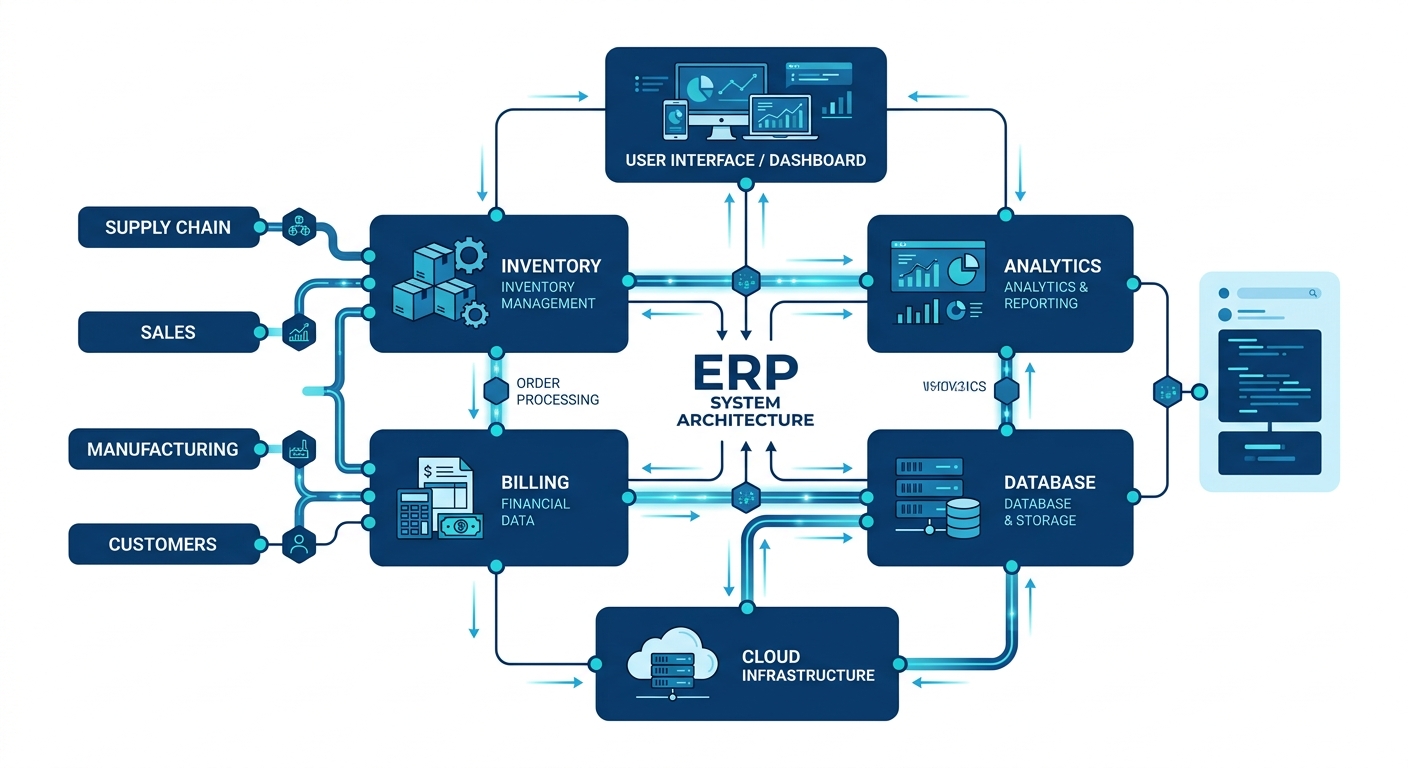
Engineering an enterprise resource planning system requires rigorous architectural discipline. Modern engineering teams favor the Node.js runtime paired with TypeScript for custom ERP backend development because of its asynchronous I/O capabilities, robust ecosystem, and native support for event-driven patterns. Below is an engineering-first blueprint detailing how to build custom erp software with node js from architectural planning to production-ready deployment.
Why Custom ERP Software Outperforms Rigid Off-the-Shelf Suites
Off-the-shelf enterprise platforms are engineered to satisfy the lowest common denominator across thousands of disparate industries. Consequently, companies spend substantial engineering capital modifying internal processes simply to fit vendor-dictated data structures. Developing custom ERP software delivers distinct advantages:
- Precision Workflow Alignment: Eliminates workarounds by building exactly the procurement, production, and accounting pipelines your teams need.
- Direct Data Ownership: Keeps critical transactional records, customer histories, and audit logs within your owned cloud infrastructure without third-party vendor lock-in.
- Seamless Ecosystem Interoperability: Integrates custom APIs directly with proprietary internal utilities, specialized hardware, and external services through our software engineering services.
- Long-Term Cost Predictability: Removes compounding annual licensing costs that penalize organizational head-count growth.
Step 1: Define Domain Boundaries and Node.js ERP Architecture
The foundation of scalable erp platform development is domain decomposition. An ERP system is a constellation of interconnected sub-domains: inventory control, general ledger accounting, order fulfillment, human resources, and customer relationship tracking.
Rather than jumping directly to microservices—which introduces distributed transaction complexity early—teams should adopt a modular monolith architecture using TypeScript and frameworks such as NestJS or Express with strict domain encapsulation.
| ERP Module | Core Backend Responsibilities | Key Node.js Components |
|---|---|---|
| Inventory & Warehousing | Stock balance reconciliation, multi-location transfers, lot/serial tracking | Optimistic locking guards, real-time WebSocket emitters |
| Sales & Billing | Order orchestration, invoice generation, tax computation (e.g., GST) | Transactional database units of work, PDF generation pipelines |
| Procurement | Purchase requisition approval cycles, vendor performance metrics | State-machine workflows, email/notification dispatchers |
| Financial Accounting | Double-entry general ledger, account balancing, journal entries | Strict ACID transaction wrappers, immutable ledger write-buffers |
Structuring each module with isolated controllers, domain services, and data repositories guarantees that individual business units can later be extracted into independent microservices if organizational scale demands it.
Step 2: Model Relational Schemas and Multi-Tenant Database Partitioning
Transactional integrity is non-negotiable for enterprise operations. A common mistake during custom erp backend development is selecting a document database for core financial workflows. A production-grade ERP requires a relational database like PostgreSQL to enforce relational constraints, foreign keys, and atomic operations.
When architecting multi-tenant ERP platforms, evaluate three standard partitioning strategies:
- Row-Level Tenant Isolation: Every table contains a
tenant_idcolumn, enforced via database queries or PostgreSQL Row-Level Security (RLS). While cost-efficient and simple to maintain, careful indexing ontenant_idalongside primary identifiers is required to avoid performance degradation. - Schema-per-Tenant: Each tenant receives a distinct schema within a shared database instance. This approach provides strong logical separation and simplifies per-tenant data migration or restoration, balancing infrastructure cost with isolation.
- Database-per-Tenant: High-compliance or enterprise-tier clients receive dedicated database instances. This maximizes security and isolation at the expense of higher infrastructure operational overhead.
Explore official best practices in the PostgreSQL Documentation to determine when table partitioning and declarative constraints make sense for your transaction volumes.
Step 3: Engineer Real-Time Concurrency for Inventory and Billing
Race conditions present a major risk in custom ERP systems. When multiple operators attempt to invoice the last remaining stock unit simultaneously, naive read-then-write backend code causes inventory overdrafts and inaccurate financial balances.
To prevent overselling and duplicate orders in Node.js ERP architecture:
- Implement Pessimistic Database Locks: For high-stakes operations, execute
SELECT ... FOR UPDATEwithin a transactional boundary. This halts concurrent transactions until the current database write completes. - Use Distributed In-Memory Locks: For distributed instances where locking database rows introduces latency, employ Redis-based distributed locking mechanisms to serialize access to high-demand stock units. Refer to the Redis Documentation for guidance on cache synchronization and high-throughput memory storage.
- Publish Real-Time Updates: Stream balance updates to frontend client interfaces using WebSockets (such as
Socket.ioor nativews). This provides live dashboard indicators to purchasing agents and warehouse floor staff.
Our engineers at Applizor design these high-reliability data pipelines through specialized custom software development services, ensuring mission-critical applications process concurrent operations without data corruption.
Step 4: Establish Granular RBAC and Immutable Audit Trails
Enterprise ERP applications must balance wide team access with strict operational guardrails. A warehouse supervisor should not inspect executive payroll data, and sales representatives should not modify approved commercial invoices.
Implement a layered security model:
- Hierarchical Role-Based Access Control (RBAC): Map distinct permissions (e.g.,
invoice:create,invoice:approve,inventory:adjust) to roles. Evaluate access dynamically in Node.js using middleware or interceptors before hitting controller logic. - Immutable Audit Logging: Create dedicated, append-only database tables that record every write action. Log the acting user identifier, timestamp, IP address, previous state, and mutated state. These tables should reject
UPDATEandDELETEoperations at the database permission level. - Data Masking: Sanitize sensitive attributes such as banking details, tax numbers, and personal identifiers at the service layer prior to API serialization.
Step 5: Implement Caching, Rate Limiting, and Background Workers
ERP usage features spiky workloads: month-end financial reporting, high-volume batch imports, and automated invoice dispatches can exhaust Node.js event loops if handled synchronously.
To build a high-performance system:
- Offload Heavy Tasks to Job Queues: Never generate bulk PDFs, calculate tax ledgers, or process batch files inside the main HTTP request-response cycle. Use queues like BullMQ powered by Redis to process workloads asynchronously across dedicated worker processes.
- Multi-Tiered Caching: Cache relatively static master data (such as country tax codes, price tiers, and chart-of-accounts definitions) in Redis to eliminate redundant database queries.
- Dynamic Rate Limiting: Deploy token-bucket rate limiters per tenant and API key. This prevents single automated scripts or runaway webhooks from degrading platform-wide responsiveness.
Step 6: Integrate Peripheral Systems and Hardware Workflows
An ERP does not operate in isolation. It coordinates with external payment gateways, logistics aggregators, e-commerce stores, tax reporting networks, and physical hardware.
Ensure your custom ERP backend provides:
- Idempotent Webhook Listeners: Always store and verify external webhook transaction IDs to avoid double-crediting balances during transient network retries.
- Standardized API Gateways: Expose well-documented REST or GraphQL endpoints secured by OAuth2 or mutual TLS (mTLS) for external partner integrations.
- Point-of-Sale (POS) and Barcode Scanner Integration: Ensure backend processing handles rapid-fire barcode scan events from warehouse terminals and retail billing points with sub-second acknowledgment.
For more architectural perspectives on modern web and enterprise platforms, review our overview of our core technology stack.
Step 7: Automate Testing, CI/CD, and Zero-Downtime Deployment
Software regressions in an ERP directly impact payroll, stock levels, and legal tax compliance. Deploying updates requires automated testing pipelines and zero-downtime infrastructure.
- Automated Calculation Testing: Unit tests must validate numerical calculations across complex accounting rules, rounding scenarios, and tax bands.
- Containerized Deployments: Package your Node.js application services into lightweight Docker containers orchestrated via Kubernetes or modern container cloud environments.
- Safe Schema Migrations: Implement blue-green or rolling deployments. Schema migrations should always be backwards-compatible (expand-and-contract pattern) so older application containers function while new containers spin up.
Frequently Asked Questions
Is Node.js fast enough for large-scale enterprise ERP systems?
Yes. Node.js handles high-concurrency I/O operations effectively due to its non-blocking event loop. As long as heavy numerical computations (such as massive matrix reports or raw image manipulation) are delegated to background job queues or optimized database views, Node.js delivers exceptional throughput for enterprise ERP workloads.
How do you handle double-entry bookkeeping constraints in Node.js?
Double-entry bookkeeping demands that every debit has an equal and corresponding credit. In a Node.js ERP, encapsulate journal postings within a single database transaction. The service must verify that sum(debits) === sum(credits) before committing; if the balance deviates by even the smallest fraction, the transaction immediately rolls back.
What is the recommended approach for migrating legacy ERP data to a custom Node.js system?
Extract, transform, and load (ETL) pipelines are essential. Cleanse legacy data into structured CSV or JSON staging datasets, run validation scripts in Node.js to ensure data integrity against your new relational constraints, and import records chronologically using streaming pipelines to avoid memory leaks.