
Legacy enterprise resource planning (ERP) platforms frequently trap growing businesses in rigid workflows, slow release cycles, and exorbitant per-seat licensing fees. For organizations with differentiated operating models, off-the-shelf software often demands costly workarounds rather than adapting to core business logic. Consequently, modern engineering teams increasingly turn to JavaScript and TypeScript runtimes to engineer bespoke internal systems.
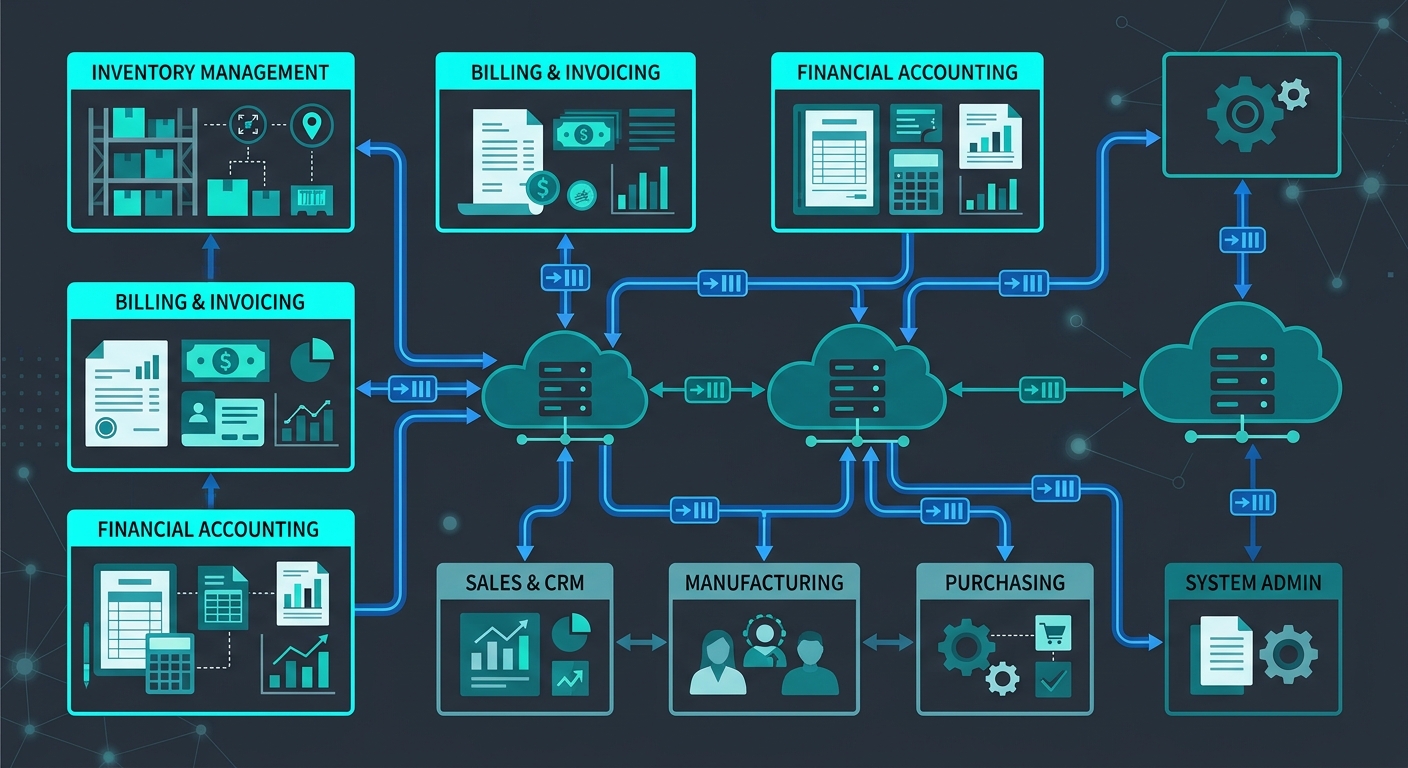
Building node js erp software offers high throughput, an expansive open-source ecosystem, and unified language ergonomics across the entire stack. Powered by the asynchronous, non-blocking I/O model of Node.js, custom ERPs can handle concurrent order ingestion, high-volume inventory adjustments, and real-time ledger updates with minimal server overhead. Below is an engineering blueprint detailing seven concrete steps to architect, design, and deploy an enterprise-grade ERP tailored for modern operations.
Architecture Decision: Modular Monolith vs. Microservices for ERP Systems
Before writing code, engineering leaders must decide how to partition their ERP’s business domains. The natural instinct for enterprise software is often to adopt microservices immediately. However, for ERP development, a premature microservice split introduces distributed transaction overhead that severely complicates core financial ledgers and inventory consistency.
| Evaluation Factor | Modular Monolith | Distributed Microservices |
|---|---|---|
| Transactional Integrity | ACID guarantees via single-database database transactions. | Requires 2-phase commits or complex Saga patterns. |
| Deployment Overhead | Single CI/CD pipeline, minimal container management. | Multiple deployment pipelines, service meshes, observability overhead. |
| Domain Boundary Drift | Enforced via internal module boundaries and strict interfaces. | Hard physical network boundaries. |
| Ideal Stage | Early-stage development to mid-scale enterprise rollout. | Hyper-scale teams with independent functional domains. |
A well-architected Node.js + NestJS ERP architecture configured as a modular monolith is often the strongest starting point. Modules (such as Billing, Inventory, Accounting, and HR) communicate internally through explicit domain services or an in-memory event bus. If a single module—such as a high-frequency warehouse barcode scanning pipeline—outgrows the shared infrastructure, it can be decoupled into an independent microservice later without redesigning the entire domain logic. For organizations reviewing their long-term system architecture, leveraging seasoned custom software development services ensures clean domain separation from day one.
Step 1: Map Core Domain Boundaries and Event Contracts
Enterprise systems depend on predictable state transitions. Begin by defining explicit business domains and identifying which module serves as the primary system of record for each business entity:
- General Ledger (GL): The authoritative source of all financial debits and credits. No external service directly modifies ledger entries; records must be appended through ledger transaction services.
- Inventory Management: Tracks physical item movements, warehouse locations, and reserved stock allocations.
- Order Management & Billing: Coordinates customer purchases, pro-forma invoicing, credit notes, and automated tax processing.
- Procurement & Vendor Management: Manages supplier purchase orders, goods received notes (GRN), and 3-way matching workflows.
Each module must expose typed interfaces and emit immutable domain events (e.g., OrderConfirmedEvent, GoodsReceivedEvent) rather than allowing foreign modules to execute arbitrary database writes directly against internal tables.
Step 2: Designing Node Js Erp Software: Multi-Tenant PostgreSQL Schema Architecture
Selecting an inappropriate tenancy model can jeopardize both security and operational scale. When building ERP system in Node and PostgreSQL setups, three primary multi-tenancy models exist:
- Database-per-Tenant: Maximum data isolation, but significant connection pooling and migration management costs.
- Schema-per-Tenant: Distinct PostgreSQL schemas within a shared database instance. Offers good separation, but DDL migrations scale poorly past several hundred tenants.
- Shared Schema with Row-Level Security (RLS): Every multi-tenant table includes an indexed
tenant_idcolumn, enforced by PostgreSQL Row-Level Security policies. This approach maximizes resource efficiency and streamlines schema migrations.
For cloud-native platforms, shared schemas managed via PostgreSQL RLS provide enterprise-grade isolation while keeping infrastructure costs manageable. Refer to the official PostgreSQL documentation on security policies to understand how tenant context is set at the session level.
Core Financial and Inventory Schema Example
An ERP cannot rely on mutable balances. To preserve auditability, inventory and accounting require double-entry mechanics and append-only event ledgers:
-- Multi-tenant Ledger Schema (PostgreSQL)
CREATE TABLE organizations (
    id UUID PRIMARY KEY DEFAULT gen_random_uuid(),
    name VARCHAR(255) NOT NULL,
    created_at TIMESTAMPTZ DEFAULT NOW()
);

CREATE TABLE accounts (
    id UUID PRIMARY KEY DEFAULT gen_random_uuid(),
    tenant_id UUID NOT NULL REFERENCES organizations(id) ON DELETE CASCADE,
    code VARCHAR(50) NOT NULL,
    name VARCHAR(150) NOT NULL,
    type VARCHAR(50) NOT NULL, -- ASSET, LIABILITY, EQUITY, REVENUE, EXPENSE
    UNIQUE(tenant_id, code)
);

CREATE TABLE journal_entries (
    id UUID PRIMARY KEY DEFAULT gen_random_uuid(),
    tenant_id UUID NOT NULL REFERENCES organizations(id) ON DELETE CASCADE,
    reference_id VARCHAR(100), -- Link to Invoice or Purchase Order
    posting_date DATE NOT NULL DEFAULT CURRENT_DATE,
    description TEXT,
    created_at TIMESTAMPTZ DEFAULT NOW()
);

CREATE TABLE journal_lines (
    id UUID PRIMARY KEY DEFAULT gen_random_uuid(),
    tenant_id UUID NOT NULL REFERENCES organizations(id) ON DELETE CASCADE,
    journal_entry_id UUID NOT NULL REFERENCES journal_entries(id) ON DELETE CASCADE,
    account_id UUID NOT NULL REFERENCES accounts(id),
    debit_amount NUMERIC(14, 4) NOT NULL DEFAULT 0.0000,
    credit_amount NUMERIC(14, 4) NOT NULL DEFAULT 0.0000,
    CONSTRAINT check_positive_amounts CHECK (debit_amount >= 0 AND credit_amount >= 0)
);

CREATE INDEX idx_journal_lines_tenant_account ON journal_lines(tenant_id, account_id);
By enforcing immutable journal lines, balances are computed via indexed materializations or summarized periodically into trial balance tables, preventing tampering and audit failures.
Step 3: Implement Backend Logic with Node.js and NestJS
When orchestrating enterprise software, unstructured backend frameworks can lead to unmaintainable codebases over time. Using the NestJS framework provides a structured dependency injection container, native TypeScript integration, and modular encapsulation designed for enterprise software.
A typical ERP module structure separates delivery mechanisms from core business rules:
- Controllers: Parse requests, validate DTOs (Data Transfer Objects), and verify tenant session context.
- Services: Execute transaction scripts, coordinate domain events, and manage entity boundaries.
- Repositories: Encapsulate ORM (such as Prisma or TypeORM) or raw query logic, preventing database leakage into service layers.
Adhering to these engineering practices simplifies long-term maintenance, especially as teams scale operations alongside broader SaaS business automation workflows.
Step 4: Implement Granular Role-Based and Attribute-Based Access Control (RBAC/ABAC)
ERP platforms house cross-departmental data ranging from sensitive payroll figures to executive profit margins. A simple admin/user flag is insufficient. The security architecture must support granular Role-Based Access Control (RBAC) paired with Attribute-Based Access Control (ABAC).
Access Control Implementation Hierarchy
- Permission Sets: Granular atoms representing specific business actions (e.g.,
invoices:create,invoices:approve,payroll:read). - Roles: Compositions of permissions assigned to users (e.g., Accounts Payable Clerk, Regional Inventory Manager).
- Scope & Attribute Filters: Restrict actions based on runtime attributes, such as assigning a user access strictly to
warehouse_id = 'WH-NORTH'.
In Node.js, this is achieved by pairing JWT or session middleware with NestJS Execution Guards. The guard verifies that the user possesses the required permission and attaches an Active Directory or database-verified tenant context to the execution request, ensuring cross-tenant data leakage is structurally impossible.
Step 5: Build Responsive Interfaces with Next.js
Modern enterprise users require responsive, desktop-caliber performance inside their browsers. Combining Next.js + Node.js for Custom ERP Development delivers an efficient balance of server-side data preparation and responsive client-side interactions.
Complex ERP screens—such as nested inventory balance grids or multi-currency financial balance sheets—can be pre-rendered using Next.js Server Components. This architecture loads relational data close to the database server, reducing round-trip latency. Interactive elements like warehouse picking consoles, line-item order entry rows, and instant stock check autocomplete components run as optimized Client Components, consuming REST or GraphQL APIs exposed by the Node.js backend.
Step 6: Handle High-Concurrency Workflows with Asynchronous Queues
One structural challenge when using Node.js for ERP systems is its single-threaded event loop. Intensive CPU tasks (such as generating large PDF invoices, crunching massive financial consolidations, or batch-updating inventory values across 50,000 SKUs) can block incoming HTTP traffic if processed synchronously on the main thread.
To maintain high availability, separate interactive API requests from asynchronous batch processing using Redis-backed queues such as BullMQ.
Real-Time Billing and Inventory Reservation Pattern
- Immediate Validation: The user submits a bulk purchase order. The Node.js API verifies basic syntax and checks real-time inventory reservation tables inside an atomic PostgreSQL transaction.
- Job Enqueueing: The transaction commits, reserving the items temporarily, and pushes an order processing payload onto the Redis message queue.
- Background Worker Processing: A dedicated worker process picks up the job, calculates multi-tier tax structures, generates the signed PDF invoice in the background, and commits the final journal entries.
- Client Notification: Upon completion, the worker pushes a WebSockets message back to the Next.js client, instantly updating the user’s dashboard without blocking operational queues.
Architectures configured with clean separation of synchronous and asynchronous workloads scale smoothly under peak seasonal loads. Review our broader capabilities on our technology and architecture page to see how scalable distributed pipelines are deployed in production.
Step 7: Enforce Audit Logging, Observability, and Deployment Pipelines
ERP systems require comprehensive operational traceability. If an inventory balance shifts unexpectedly or an invoice status changes from draft to cancelled, administrators must be able to identify who initiated the change, the exact timestamp, and the previous state of the record.
- Immutable Change Logs: Implement PostgreSQL trigger-based audit logging or application-level interceptors that capture JSON diffs for every state mutation across critical tables.
- Structured Logging and Tracing: Use OpenTelemetry and structured logging libraries (such as Pino) to correlate HTTP requests with downstream database queries and message queue jobs.
- Automated Database Migrations: Use strict schema migration tools integrated into CI/CD pipelines. Never permit manual DDL alterations against production ERP instances.
- Containerization and Orchestration: Package the Node.js API, queue workers, and Next.js frontends into isolated Docker containers deployed across managed container clusters (such as AWS ECS or Kubernetes), allowing individual services to scale independently based on CPU and memory demands.
Key Pitfalls to Avoid in Custom Node.js ERP Development
When teams decide on how to build custom erp software with node js, common design oversights can result in technical debt that hinders long-term scalability:
- Floating Point Math for Financials: JavaScript’s native
Numbertype uses IEEE-754 double-precision floating-point arithmetic, which leads to rounding errors in monetary sums (e.g.,0.1 + 0.2 !== 0.3). Always use arbitrary-precision decimal libraries (such asdecimal.jsorbignumber.js) and map to PostgreSQLNUMERICcolumns. - Ignoring Database Deadlocks in Inventory Rows: High-velocity concurrent orders attempting to reserve the exact same stock items can trigger database deadlocks. Mitigate this by sorting line items consistently before issuing locking queries (such as
SELECT ... FOR UPDATE) within transactional blocks. - Neglecting Tenant Separation in Redis Caching: When caching product catalogs or user profiles in Redis, always prefix cache keys with the tenant ID (e.g.,
tenant:tenant_id:product:sku) to prevent accidental data contamination between client organizations.
Frequently Asked Questions About Node Js ERP Software
Can Node.js handle heavy enterprise accounting calculations?
Yes. While Node.js runs an event-driven main thread, heavy computational jobs—such as depreciation schedules, foreign currency adjustments, and consolidated balance sheet aggregations—can be delegated to worker threads, background queue processors, or optimized native database queries. The Node.js event loop handles thousands of concurrent I/O requests efficiently while external workers handle CPU-heavy workloads.
Why choose PostgreSQL over MongoDB for a Node.js ERP?
Enterprise resource planning systems rely heavily on structured relations, referential integrity, and atomic transactions. PostgreSQL provides ACID compliance, strong schema enforcement, and mature support for complex joins, foreign keys, and Row-Level Security. MongoDB can be useful for unstructured metadata or document logs, but relational databases remain the industry standard for financial ledgers and transactional integrity.
What is the recommended approach for integrating legacy hardware (e.g., barcode scanners, thermal printers)?
Hardware integrations can communicate with the Node.js backend using standard protocols. Network-enabled barcode scanners and IoT weight scales can transmit payloads via WebSockets, MQTT, or dedicated REST endpoints. Thermal receipt printers can receive jobs via server-side ESC/POS formatting services dispatched over local print agents or cloud print gateways.