
Legacy off-the-shelf enterprise resource planning systems frequently encumber growing businesses with rigid subscription models, bloated dependency trees, and workflows tailored for generic operations rather than specific operational edges. When scaling companies reach the functional limits of boxed software, engineering an in-house platform becomes a strategic priority. Selecting a Node.js Custom ERP architecture enables engineering teams to build modular, event-driven, and highly reactive systems capable of unifying inventory, finance, order pipelines, and resource scheduling under a single digital roof.
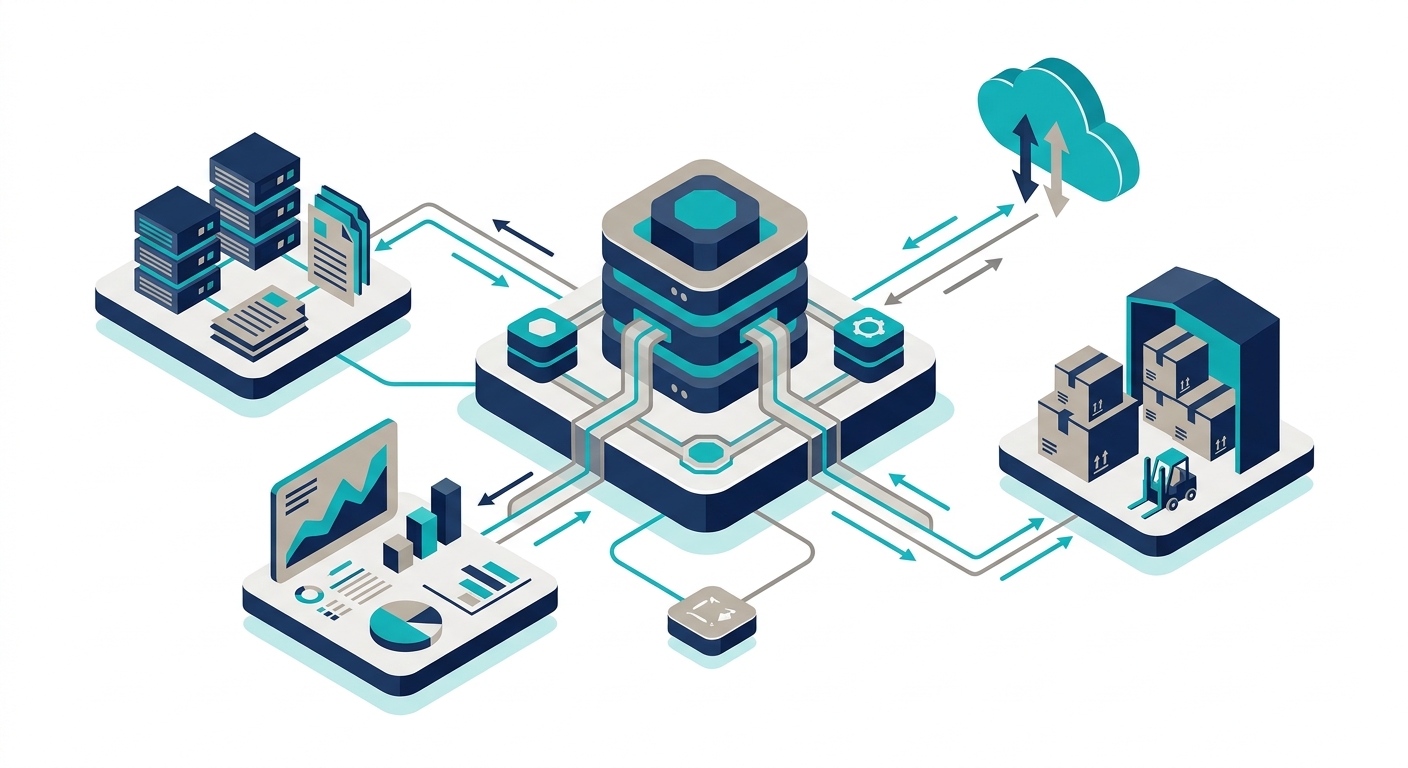
Node.js has evolved far beyond lightweight API routing; its event-driven, non-blocking I/O model makes it a formidable runtime for data-intensive business applications. When paired with modern architectural patterns like domain-driven modular monoliths, typed contracts, and enterprise databases, custom software development services can construct platforms that respond in real time across distributed facilities without buckling under concurrent operational load.
Architectural Foundations for a Node.js Custom ERP
Before writing the first lines of code, technical leaders must evaluate whether to organize the platform as a modular monolith or as distributed microservices. While microservices offer isolated deployments, they introduce severe operational overhead, distributed transaction complexities (such as the Saga pattern), and network latency between interdependent business units.
For most mid-market and enterprise implementations, a modular monolith represents the optimal balance. A modular monolith enforces strict domain boundaries inside a unified codebase (often structured using frameworks like NestJS with TypeScript). Each bounded context—such as Billing, Inventory, Human Resources, or Customer Relations—maintains its own isolated domain logic, data models, and service interfaces. If a specific operational module later demands independent horizontal scaling (such as high-frequency warehouse scanning or real-time telematics), it can be extracted into an autonomous microservice without requiring an overhaul of the entire ERP domain.
The Core Custom Enterprise Resource Planning Tech Stack
Designing an enterprise backbone requires tooling that provides static type checking, transactional integrity, low-latency state synchronization, and reliable asynchronous processing. A production-ready custom enterprise resource planning tech stack typically comprises:
- Runtime & Application Framework: Node.js (Active LTS) paired with TypeScript and NestJS or Fastify for structured dependency injection, validation pipes, and automated OpenAPI contract generation.
- Relational Storage: PostgreSQL for transactional consistency (ACID compliance), complex join handling, row-level security, and audit partitioning.
- In-Memory Layer & Job Queues: Redis for distributed caching, user session stores, mutex locking during transactional balance recalculations, and BullMQ for reliable background job processing.
- Presentation Layer: Modern front-end frameworks like Next.js or React with TypeScript, communicating via secure REST or GraphQL endpoints with Server-Sent Events (SSE) or WebSockets for live telemetry.
- Infrastructure: Docker containers orchestrated via Kubernetes or managed container platforms, deployed through robust CI/CD pipelines on modern cloud infrastructure.
7 Steps: How to Build Custom ERP Software with Node.js
Executing an enterprise-grade ERP project requires a disciplined engineering roadmap. Below are the seven key phases of Node.js ERP system development from domain scoping to production deployment.
Step 1: Domain Discovery and Bounded Context Definition
Every ERP failure traces back to misunderstood business processes. Begin by running Event Storming workshops with departmental stakeholders (finance, procurement, warehouse operations, and executive leadership). Identify core aggregate roots, domain events (such as PurchaseOrderApproved or StockDepleted), and data ownership boundaries. Enforce strict isolation: the Inventory module must not directly mutate records owned by the Accounting ledger; cross-domain synchronization must occur through defined internal domain events or explicit application service interfaces.
Step 2: Database Schema Design (PostgreSQL & Redis)
An ERP system relies heavily on strict transactional accounting and auditability. Design your relational schemas using immutable, append-only ledger designs for financial and inventory entries rather than direct row updates.
| Module | Storage Strategy | Primary Schema Pattern |
|---|---|---|
| General Ledger & Billing | PostgreSQL | Double-entry bookkeeping table, immutable append-only records with strict foreign keys and check constraints. |
| Warehouse & Stock | PostgreSQL + Redis | PostgreSQL holds physical inventory movements; Redis maintains real-time available-to-promise (ATP) counters with distributed locks. |
| Session & Permissions | Redis | Cached permission matrices and JSON Web Token (JWT) revocation lists for zero-lookup authorization validation. |
| Audit Trails | PostgreSQL (Partitioned) | Time-partitioned tables capturing timestamp, actor UUID, IP, previous state, and delta updates in jsonb format. |
Refer to the official PostgreSQL documentation when configuring transactional isolation levels (such as SERIALIZABLE or REPEATABLE READ) for mission-critical operations like financial period closes.
Step 3: Structuring the Modular Backend Architecture
Organize the backend using clean architecture principles. Isolate infrastructure concerns (database drivers, email providers, third-party logistics APIs) from pure business domain logic. A typical domain module in your Node.js application should adhere to this folder separation:
/domain: Contains pure business entities, value objects, and repository interfaces devoid of external library imports./application: Contains use-case handlers, command and query objects (CQRS), and event listeners./infrastructure: Implements repository interfaces using Object-Relational Mapping (ORM) tools like Prisma or raw SQL query builders like Kysely, alongside external HTTP clients./presentation: Houses HTTP controllers, input validation schemas (such as Zod or class-validator), and response serialization mappers.
Step 4: Implementing Multi-Tenancy and Role-Based Access Control (RBAC)
Enterprise platforms often require multi-tenant partitioning or branch-level data governance. Implement authorization at both the API gateway and the database layers. At the application layer, utilize declarative guards in Node.js to evaluate role permissions against fine-grained policies (e.g., can:approve:purchase_order). At the database layer, enforce tenant isolation through PostgreSQL Row-Level Security (RLS) by injecting the active tenant context into the database transaction session parameters.
Step 5: Secure Third-Party Integrations and Ingestion
An ERP cannot exist in a vacuum. It must connect with electronic data interchanges (EDI), tax authorities, banking APIs, payment gateways, and freight carriers. To ensure stability:
- Centralize outbound calls using robust HTTP client interceptors with exponential backoff and circuit-breaking logic.
- Sign and verify every incoming webhook using asymmetric cryptographic signatures (HMAC SHA-256).
- Persist every incoming integration payload to an append-only inbox table before triggering asynchronous business workers, ensuring idempotency and data recovery during external outages.
If you are coordinating broader operations across web properties or automated back-office flows, explore Applizor’s integrated software engineering services to streamline complex system interconnects.
Step 6: Asynchronous Processing and Event Queues
Long-running computations—such as generating monthly balance sheets, generating batch PDF invoices, or synchronizing inventory across thousands of SKUs—must never block the Node.js main event loop. Leverage Redis-backed job queues (such as BullMQ) to offload these workloads to dedicated worker processes. Structure critical workflows around the Transactional Outbox pattern: write the domain event to your PostgreSQL transactional log within the primary database transaction, then use a background poller or write-ahead log (WAL) listener to dispatch jobs to the queue. This prevents message loss during application crashes.
Step 7: Observability, Error Handling, and Deployment
Enterprise operations require granular visibility. Standardize application error handling using domain-specific error classes that map predictably to operational alerts and HTTP status codes. Implement distributed tracing using OpenTelemetry to profile database queries and inter-service latency. Containerize the service using minimal Alpine or distroless Node.js base images, execute automated health checks, and manage deployments with blue-green or canary release strategies on container platforms.
Performance Scaling Strategies for Enterprise Workloads
Node.js is renowned for its throughput, but compute-heavy tasks can saturate the single-threaded event loop if not architected correctly. Refer to the Node.js API documentation for standard runtime configurations, and adopt the following optimization patterns for enterprise workloads:
- Offload CPU-Intensive Tasks: Allocate tasks like heavy data transformation, PDF/Excel generation, and cryptography to Node.js Worker Threads or dedicated micro-services written in languages optimized for parallel compute.
- Connection Pooling: Fine-tune database connection pools (via PgBouncer or native ORM pool managers) to prevent exhausting database file descriptors during sudden traffic surges.
- Cache Invalidation Rigor: Avoid global key sweeps in Redis; use key tagging or publish/subscribe notifications to purge cached ERP records only when underlying entities change.
- Graceful Degradation: Implement circuit breakers on non-critical modules (such as notifications or analytics) so that transient failures do not compromise primary billing or order fulfillment operations.
Custom Platform vs. Packaged Software: The Strategic Decision
Developing a custom ERP demands an upfront engineering investment, but it yields profound operational agility. While off-the-shelf platforms impose recurring per-user licensing fees and force businesses to mold their workflows around vendor limitations, a custom Node.js architecture belongs entirely to the enterprise. It scales predictably, automates proprietary operational advantages, and adapts continuously as business models evolve. For organizations seeking tailored digital systems, exploring modular business platforms and billing products can provide a strong foundation or point of reference when planning enterprise-wide digital transformation.
Frequently Asked Questions
Why choose Node.js over Java or .NET for enterprise ERP development?
Node.js provides exceptional developer velocity, a unified JavaScript/TypeScript language across front-end and back-end teams, and a non-blocking I/O model that efficiently handles high-concurrency API integrations, real-time messaging, and microservice orchestration without the memory overhead common to traditional multi-threaded runtimes.
Can Node.js ensure strict financial transactional consistency?
Yes. Transactional integrity is enforced primarily by the database management system. When Node.js is paired with ACID-compliant relational databases like PostgreSQL, and transactions are managed using correct isolation levels and append-only ledgers, it delivers the same mathematical consistency and reliability as any traditional enterprise runtime.
How long does it take to develop a custom ERP using Node.js?
A baseline Minimum Viable Product (MVP) covering core inventory, basic billing, and user management typically takes between 3 to 6 months of focused development. Comprehensive enterprise systems with multi-branch synchronization, advanced manufacturing scheduling, and compliance workflows generally develop through continuous modular releases over 9 to 18 months.