
Introduction
For Small and Medium Enterprises (SMEs), choosing the right Enterprise Resource Planning (ERP) system is a pivotal decision that can shape operational efficiency, growth trajectory, and competitive advantage. The core dilemma often boils down to two main options: investing in a custom-built ERP solution or adopting an off-the-shelf package. Both paths offer distinct advantages and challenges, making the choice far from straightforward.

This article aims to provide a comprehensive guide for startup founders, SME owners, operations leaders, and IT managers, outlining 7 ultimate factors to consider when evaluating custom ERP vs off-the-shelf solutions. We’ll delve into aspects like Total Cost of Ownership (TCO), unique workflow optimization, scalability, and integration capabilities, offering a practical framework to help you make an informed decision that aligns with your business goals.
Understanding Custom ERP vs Off-the-Shelf Solutions
Before diving into the comparison, let’s clarify what each term entails:
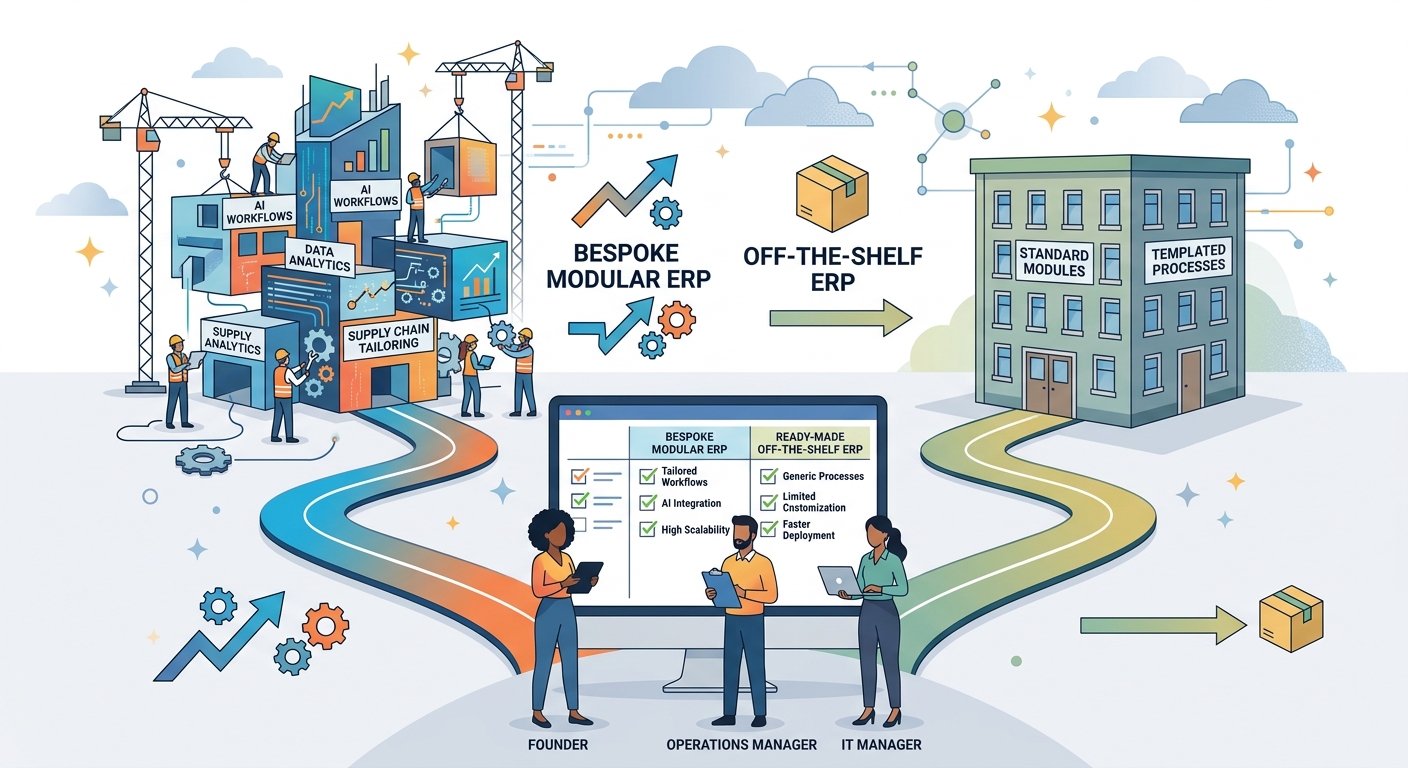
- Custom ERP: This refers to an ERP system specifically designed, developed, and implemented for a single organization. It’s built from the ground up to match the company’s precise processes, data structures, and operational needs. Think of it as a tailor-made suit for your business.
- Off-the-Shelf ERP: These are pre-packaged, standardized ERP software solutions available commercially (e.g., SAP, Microsoft Dynamics, Odoo, Oracle NetSuite). They come with a broad set of features and functionalities designed to cater to a wide range of businesses across various industries. You configure and adapt your business processes to fit the software’s capabilities, much like buying a ready-made suit.
7 Ultimate Factors for SMEs to Consider
1. Workflow Fit and Business Uniqueness
Does your business operate with highly specialized processes that give you a competitive edge? Or do you follow standard industry practices?
- Custom ERP: Offers an exact fit for your unique workflows. If your operations involve proprietary methods, complex manufacturing sequences, or distinct service delivery models, a custom solution can be built to optimize these specific processes without compromise. This ensures your software enhances, rather than dictates, your operational efficiency. For example, a niche e-commerce platform with a unique fulfillment logic might find off-the-shelf solutions restrictive, whereas a custom ERP could perfectly integrate their specific inventory management and shipping algorithms.
- Off-the-Shelf ERP: Requires businesses to adapt their processes to the software’s predefined functionalities. While many off-the-shelf systems are highly configurable, they might still necessitate workarounds for truly unique operations. This can lead to inefficiencies or a loss of competitive advantage if your core business differentiator is tied to a non-standard workflow.
2. Total Cost of Ownership (TCO) Beyond Initial Price
The sticker price is just the beginning. TCO encompasses all costs associated with an ERP system over its entire lifecycle, typically 5-10 years.
- Custom ERP:
- Higher Upfront Investment: Development costs are significant as you’re building from scratch.
- Ongoing Costs: Includes maintenance, support, hosting (often on cloud platforms like AWS or GCP), and potential future enhancements. However, these costs are typically predictable and don’t scale directly with user count.
- Hidden Costs: Can include extensive internal team involvement during development, potential for scope creep if requirements aren’t tightly managed, and the need for dedicated IT resources.
- Long-term Value: You own the intellectual property. There are no recurring license fees per user, which can lead to lower costs as your team grows.
- Off-the-Shelf ERP:
- Lower Upfront Investment: Primarily involves licensing fees (often subscription-based) and implementation costs.
- Ongoing Costs: Dominated by recurring subscription fees (per user, per module), annual support contracts, and costs for upgrades. These costs can escalate significantly as your team expands or you add more functionalities.
- Hidden Costs: Can include extensive customization costs (which can make future upgrades problematic), training for workarounds, data migration complexities, and potential vendor lock-in fees for data export or switching.
- Long-term Value: Predictable monthly/annual fees, but the cumulative cost can surpass custom solutions over time, especially for growing SMEs with many users.
3. Scalability and Future-Proofing
Your ERP should grow with your business, not constrain it.
- Custom ERP: Designed with your future growth in mind. It can be built to easily integrate new modules, adapt to evolving business models, or incorporate emerging technologies like AI automation, RAG knowledge bases, or voice bots. This provides significant flexibility to pivot and expand without being limited by vendor roadmaps.
- Off-the-Shelf ERP: Offers scalability within the vendor’s ecosystem. Adding users or modules is usually straightforward but comes with increased subscription costs. However, extensive customizations made to an off-the-shelf system can complicate or even break during vendor-mandated upgrades, hindering future scalability and requiring costly re-customization.
4. Integration Capabilities
How well will your new ERP communicate with your existing systems (CRM, e-commerce, POS, IoT devices, etc.)?
- Custom ERP: Provides unparalleled flexibility for integration. It can be specifically engineered to connect seamlessly with all your existing software, legacy systems, and even IoT devices or external APIs. This allows for a truly unified data flow and automated processes, leveraging tools like n8n workflow automation for complex inter-system communication.
- Off-the-Shelf ERP: Relies on pre-built connectors or APIs provided by the vendor. While many popular integrations are supported, connecting to highly specialized or legacy systems might require custom development, third-party middleware, or manual data transfers, adding complexity and cost.
5. Implementation Time and Resources
How quickly do you need your ERP up and running, and what internal resources can you dedicate?
- Custom ERP: Typically has a longer development and implementation cycle, ranging from several months to over a year, depending on complexity. It demands significant involvement from your internal teams (stakeholders, subject matter experts) during the requirements gathering, design, and testing phases.
- Off-the-Shelf ERP: Generally offers a faster time to deployment, as the core software is ready. However, don’t underestimate the time and effort required for configuration, data migration, user training, and process adjustments. A typical SME rollout can still take 3-6 months.
6. Vendor Lock-in and Control
Who owns the software, and how much control do you have over its future?
- Custom ERP: You own the source code and the data. This provides maximum control over the system’s evolution, security, and hosting. You are not dependent on a single vendor’s roadmap or pricing changes, reducing vendor lock-in.
- Off-the-Shelf ERP: You license the software; the vendor owns the code. You are tied to the vendor’s update schedule, feature releases, and pricing models. Switching vendors can be a complex, costly, and disruptive process involving data migration and re-implementation.
7. Maintenance, Support, and Updates
Who is responsible for keeping the system running smoothly?
- Custom ERP: Maintenance, support, and updates are managed by your internal IT team or a dedicated development partner like Applizor Softech. This allows for immediate bug fixes, tailored enhancements, and updates specific to your business needs (e.g., GST or other statutory compliance).
- Off-the-Shelf ERP: The vendor typically handles core software updates, security patches, and general support. However, if your system has significant customizations, these might need to be re-applied or re-developed after each major vendor update, incurring additional costs and potential downtime.
Making the Right Choice: A Practical Framework for SMEs
To navigate this complex decision, consider the following steps:
- Define Your Unique Processes & Needs: Document your core business processes. Identify what makes your operations unique and where standard solutions might fall short. What are your non-negotiable requirements?
- Map Out Your Growth Trajectory: Project your business needs for the next 3-5 years. Will you expand into new markets, launch new product lines, or significantly increase employee count? Your ERP must support this vision.
- Conduct a Thorough TCO Analysis: Look beyond initial quotes. Account for all potential costs over the system’s lifespan, including licenses, implementation, customization, maintenance, training, and potential integration challenges.
- Assess Integration Requirements: List all existing systems that need to communicate with your ERP. Evaluate the complexity and cost of integrating them with both custom and off-the-shelf options.
- Evaluate Internal Resources & Expertise: Do you have the internal IT talent to manage a custom development project or to deeply configure and support a complex off-the-shelf system? If not, factor in the cost of external partners.
- Consider a Hybrid Approach: Sometimes, the best solution is a blend. You might opt for an off-the-shelf ERP for standard functions (like finance) and develop custom modules or integrations for your truly unique, differentiating processes.
How Applizor Softech Can Help
At Applizor Softech LLP, we understand the challenges SMEs face in digital transformation. Whether you lean towards a fully custom solution or need expert assistance in integrating and optimizing an off-the-shelf system, our team brings extensive experience in:
- Custom ERP/SaaS Development: Crafting bespoke solutions tailored to your exact business processes, ensuring optimal workflow fit and competitive advantage.
- AI Automation & Integration: Building AI agents, RAG knowledge bases, n8n workflow automation, and voice bots that seamlessly integrate with your ERP, enhancing efficiency and decision-making.
- Cloud & DevOps: Ensuring your ERP solution is scalable, secure, and performant on leading cloud platforms like AWS and GCP, with robust CI/CD pipelines.
- Strategic Consulting: Guiding you through the decision-making process, from requirements analysis to implementation strategy, to ensure your investment delivers maximum value.
From custom Applizor ERP and Company OS to specialized retail/POS and pharmacy billing systems, we build solutions that empower your business for sustainable growth.
Conclusion
The choice between custom ERP and off-the-shelf is a strategic one, with no universal right answer. For SMEs, it’s about aligning your ERP strategy with your unique business model, growth aspirations, and long-term financial health. By carefully evaluating factors like workflow fit, TCO, scalability, and integration capabilities, you can make a decision that not only streamlines your operations today but also future-proofs your enterprise for tomorrow’s challenges and opportunities.
Frequently Asked Questions (FAQs)
What is the main difference between custom and off-the-shelf ERP?
The main difference lies in their design philosophy: Custom ERP is built from scratch to perfectly match an organization’s unique processes, offering an exact fit. Off-the-shelf ERP is a pre-built, standardized package configured to meet common business needs, requiring companies to adapt their processes to the software.
Which ERP is cheaper for SMEs, custom or off-the-shelf?
Initially, off-the-shelf ERP often appears cheaper due to lower upfront licensing and implementation costs. However, when considering the Total Cost of Ownership (TCO) over 5-10 years, including recurring subscription fees, customization costs, and scalability challenges, a custom ERP can sometimes prove more cost-effective, especially for growing SMEs with many users or highly specialized needs.
When should an SME choose a custom ERP?
An SME should consider a custom ERP if its core business processes are highly unique, provide a significant competitive advantage, cannot be adequately supported by off-the-shelf solutions without extensive workarounds, or if the business requires deep integration with specialized existing systems or emerging technologies like AI automation without vendor lock-in.
Can off-the-shelf ERP be customized?
Yes, most off-the-shelf ERP systems offer configuration options and some level of customization. However, extensive customization can increase implementation costs, complicate future upgrades, and potentially lead to vendor lock-in. It’s crucial to distinguish between configuration (adjusting settings within the system’s framework) and true customization (modifying the underlying code or adding new functionalities).