
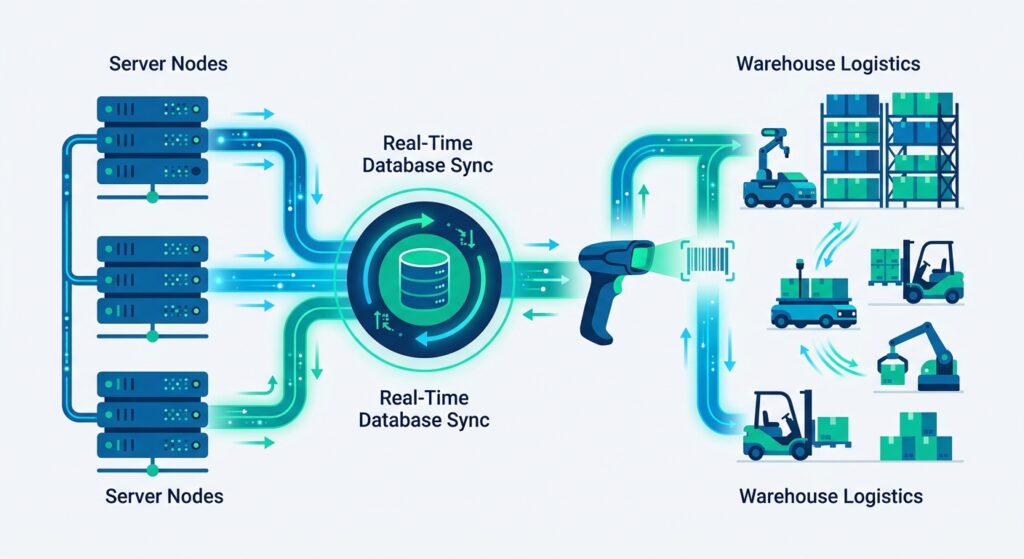
Off-the-shelf Enterprise Resource Planning (ERP) tools and inventory software often fall short when operations scale. High-frequency retail checkouts, multi-location stock movements, and complex catalog hierarchies demand zero latency and tailor-made workflows. Developing a system tailored to your exact operational requirements ensures your architecture scales seamlessly alongside operational complexity.
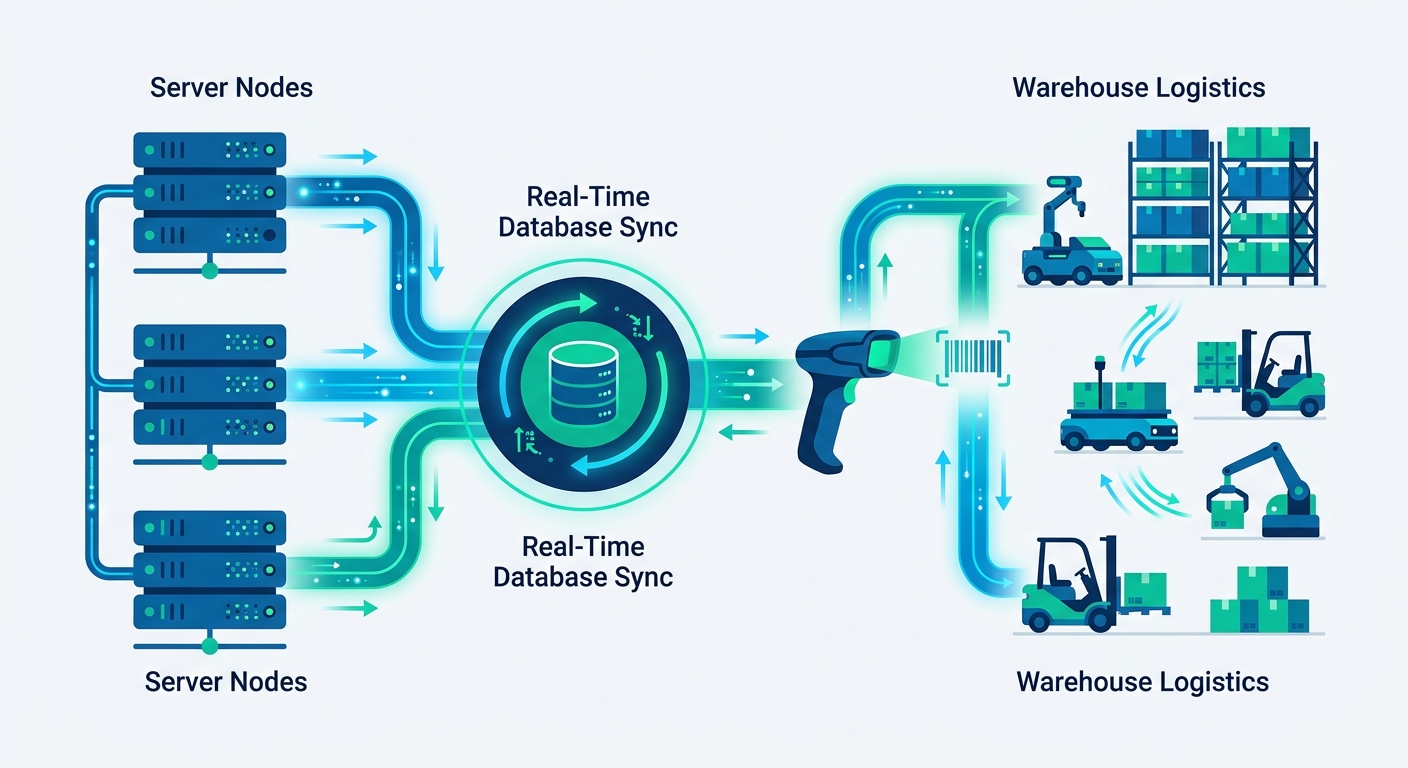
Using an asynchronous, event-driven runtime like Node.js allows teams to build lightweight, microsecond-responsive backends capable of orchestrating thousands of concurrent stock allocations without bottlenecks. Below is an engineering roadmap detailing how to build a resilient backend for custom inventory management, spanning transactional safety, API design, security, and cloud deployment.
Why Choose Node.js for Custom Inventory Management?
Inventory backends present a unique challenge: they are inherently read-heavy during product catalog browsing, yet fiercely write-sensitive during checkout bursts, warehouse intake batches, and point-of-sale (POS) reconciliation. Node.js stands out for these requirements due to several foundational characteristics:
- Non-blocking I/O: Node.js handles incoming inventory reservations, barcode scanner events, and audit logs simultaneously on a single event loop without spawning heavy thread pools per request.
- Unified JavaScript/TypeScript Ecosystem: Shared data models and validation schemas across frontend dashboards, mobile warehouse scanners, and backend services reduce friction.
- Rich Data Layer Connectors: Whether you implement an inventory management system with node express and mongodb or utilize relational drivers via Prisma and PostgreSQL, Node.js offers enterprise-grade Object-Relational Mappings (ORMs) and database clients.
If you are reviewing whether to build proprietary platforms or integrate ready-made infrastructure, explore our custom software development services to align your technical roadmap with core business drivers.
Step 1: Domain Modeling and Database Architecture
The foundation of any reliable inventory system lies in its data model. A common architectural failure is maintaining only a mutable single-column stock balance (such as a generic quantity field). If multiple processes mutate that value simultaneously without traceability, discrepancies become inevitable.
The Double-Entry Inventory Ledger Pattern
Enterprise systems treat stock changes like financial ledgers. Instead of overwriting quantities directly, you record immutable stock transactions containing source locations, destination locations, item quantities, and movement reasons (for example: PURCHASE_RECEIPT, POS_SALE, RETURN, DAMAGED). The current on-hand quantity is calculated as the sum of ledger transactions, or stored in a materialized view cached in memory.
| Requirement | Relational (PostgreSQL / MySQL) | Document Store (MongoDB) |
|---|---|---|
| Consistency | Strict ACID across tables via transactions | ACID within documents; multi-document transactions supported |
| Schema Flexibility | Rigid schema; ideal for SKU variations, serialized batches, and tax mapping | Flexible schema; ideal for diverse product attributes and non-uniform metadata |
| Audit Logging | Relational integrity ensures audit logs never orphan product records | Embedded arrays or time-series collections for event histories |
For operations combining retail billing and multi-channel synchronization, PostgreSQL or MySQL accessed via Prisma or TypeORM is generally preferred due to strict relational integrity, while MongoDB remains viable when product catalogs have highly variable attributes.
Step 2: Structuring the Node.js Inventory Management System API
Maintainability starts with clean architectural separation. Avoid placing SQL queries or database mutations inside Express route handlers. Adopt a layered Clean Architecture structure:
- Controllers Layer: Handles HTTP transport, parses incoming request payloads, validates schemas (using tools like Zod or Joi), and delegates to services.
- Services Layer: Contains business rules, such as checking minimum safety thresholds, verifying reorder points, calculating taxes, and managing transaction boundaries.
- Repositories / Data Access Layer: Executes database queries using Prisma, Mongoose, or raw SQL queries, keeping the persistence layer isolated.
- Event / Queue Producers: Emits asynchronous events (e.g., StockDepleted, OrderFulfillable) to Redis or message brokers for non-blocking notifications.
This decoupling ensures that if your team transitions from Express to another HTTP framework or introduces an alternate database engine, the business logic remains intact.
Step 3: Handling High-Concurrency Billing and Race Conditions
During peak sales cycles or flash sales, hundreds of requests may attempt to reserve the same inventory stock simultaneously. If two requests read a stock level of 1 unit at the same millisecond, both might approve the checkout—causing an oversell. Mitigating this requires explicit concurrency control strategies.
Optimistic vs. Pessimistic Locking
Optimistic Locking: Ideal for systems with moderate contention. Each inventory record contains a version counter. When updating the stock balance, the application checks whether the version is still identical to the version fetched at the start of the read. If the version changed, the transaction aborts and retries.
Pessimistic Locking: Necessary for high-volume POS and retail billing. The application locks the specific database row (such as running a SELECT FOR UPDATE statement within a relational transaction). Concurrent transactions queue behind the lock until the active transaction commits or rolls back, guaranteeing zero duplicate deductions.
Atomic Stock Decrements in MongoDB
When running an inventory management system with node express and mongodb, leverage atomic operators like $inc with a conditional check. By ensuring the condition matches only when the quantity is greater than or equal to the requested reduction, MongoDB performs the deduction atomically in a single operation, eliminating the need for complex application-level mutexes.
Step 4: Implementing Real-Time Multi-Location Stock Synchronization
Modern businesses run simultaneous operations across brick-and-mortar stores, e-commerce storefronts, and regional distribution centers. When a cashier scans an item at a physical register, every digital channel must reflect that inventory reduction instantaneously.
In a Node.js inventory application tutorial or production rollout, real-time push events are handled through WebSocket connections (such as Socket.IO) or Server-Sent Events (SSE). An effective architecture uses a Redis Pub/Sub backplane:
- The checkout service commits the stock reduction transaction in the primary database.
- The service publishes an event (e.g., INVENTORY_UPDATED) to a shared Redis channel containing the updated SKU, warehouse ID, and new available balance.
- Node.js WebSocket gateway instances subscribe to Redis and broadcast the update to connected POS terminals, administrative dashboards, and warehouse pickers within milliseconds.
Organizations seeking robust operational suites can evaluate our pre-engineered enterprise software and business management products designed to centralize inventory, billing, and retail workflows.
Step 5: Enforcing Role-Based Access Control (RBAC) and API Security
Inventory systems manage valuable financial assets. Unrestricted endpoints invite internal theft, accidental stock adjustments, and administrative errors. Implement strict Role-Based Access Control (RBAC) directly inside your Node.js inventory management system API middleware.
- Granular Permissions: Separate coarse roles (Admin, Cashier, Warehouse Operator, Auditor) into fine-grained permissions like inventory:read, stock:adjust, price:override, and po:approve.
- Stateless Authentication: Use JSON Web Tokens (JWT) with brief time-to-live (TTL) limits paired with Redis-backed refresh token rotation.
- Audit Logging Middleware: Every endpoint that modifies quantity or location must capture the user ID, client IP address, timestamp, pre-change value, and post-change value into an append-only audit table.
- Rate Limiting: Protect publicly exposed barcode lookup and inventory lookup endpoints against scraping attacks using Redis-backed token bucket rate limiters.
Step 6: Connecting POS Hardware, Barcode Scanning, and ERP Systems
A custom inventory management system must bridge digital logic with real-world warehouse operations. Node.js backends can readily interface with edge devices and third-party enterprise platforms:
Handheld Scanners and Mobile Apps: Build REST or GraphQL endpoints optimized for low-bandwidth environments. When warehouse staff scan GS1-128 or UPC barcodes using mobile cameras or dedicated Android scanners, the payload should batch requests to prevent server saturation during bulk intake.
Financial & GST Compliance: In markets requiring strict compliance, every inventory movement tied to a sale or purchase must calculate applicable tax breakdowns and generate e-invoices. Decouple tax calculation engines into background worker queues to ensure that invoice generation does not block the checkout flow. Discover more about our technology practices on our engineering and tech stack overview.
Step 7: Production Cloud Deployment and CI/CD Pipelines
Deploying a production-grade Node.js system requires containerization, zero-downtime rolling updates, and resilient database provisioning. Following modern DevOps practices ensures your system handles unpredictable traffic spikes effortlessly.
Containerization and Orchestration
Package the Node.js runtime using lightweight Alpine or distroless Docker images. Run the service as an unprivileged user (non-root) to prevent container escape vulnerabilities. Deploy the containerized application on scalable infrastructure such as Amazon Web Services (AWS) ECS with Fargate or Google Cloud Run.
Automated CI/CD Workflow
Set up an automated deployment pipeline (using GitHub Actions, GitLab CI, or Bitbucket Pipelines) structured around the following gates:
- Linting & Type-Checking: Run static analysis to detect syntax issues and unhandled promises.
- Unit & Integration Testing: Spin up temporary PostgreSQL or MongoDB test containers (using Testcontainers) to execute comprehensive transaction tests, locking verifications, and permission assertions.
- Security Scanning: Check npm dependencies for vulnerabilities using automated software composition analysis (SCA).
- Canary or Blue-Green Deployment: Route 10% of production traffic to the new build, monitor error rates and database query latencies, and promote to 100% traffic once health metrics remain stable.
Frequently Asked Questions
How do you prevent race conditions during flash sales in Node.js?
To prevent overselling, combine an in-memory reservation layer (using Redis atomic operations like DECRBY or Lua scripts) with database-level pessimistic locking (SELECT FOR UPDATE in SQL engines). The Redis layer quickly rejects requests once available inventory hits zero, protecting the primary database from catastrophic query spikes.
Should I use PostgreSQL or MongoDB for custom inventory management?
Use PostgreSQL if your business operates high-volume physical retail billing, complex multi-warehouse transfers, and strict financial accounting, where relational integrity and strict ACID transactions are paramount. Use MongoDB if your catalog features diverse product attributes (e.g., custom apparel or industrial spare parts with varying technical specifications) and your team prefers JSON-native document models.
What is the most effective way to audit inventory stock adjustments?
Implement an immutable, append-only ledger pattern. Never directly overwrite an inventory figure without recording a discrete stock movement record containing the associated user ID, reason code, reference document number, and timestamp. This creates an unalterable paper trail for accountants and operations managers.