
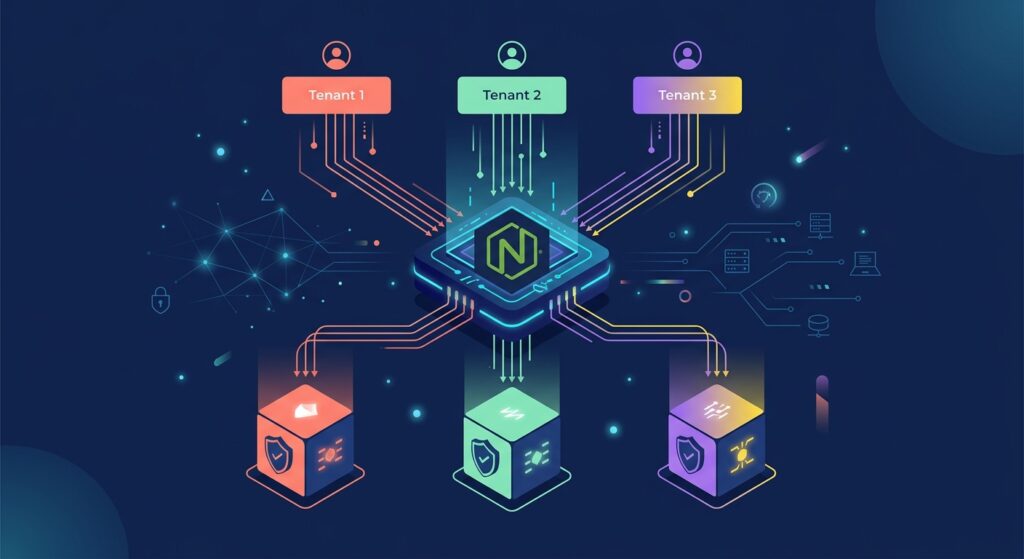
Building a Software-as-a-Service (SaaS) platform requires handling shared computational resources while guaranteeing strict logical boundaries between organizational customers. In a typical single-tenant system, application logic and data stores map to a single entity. However, engineering a node js multi tenant saas demands an architecture where one running instance serves hundreds or thousands of discrete tenants without cross-contamination.
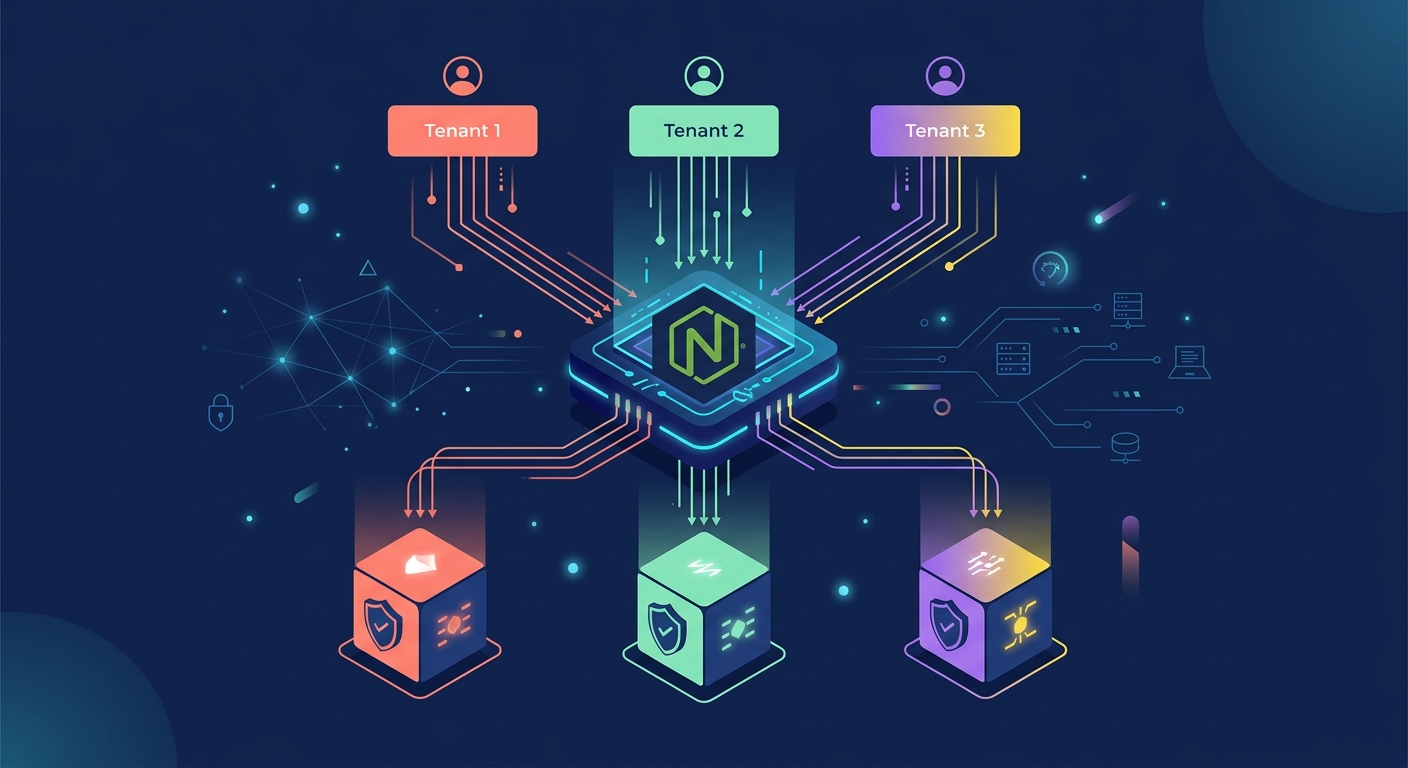
A missed isolation check in a multi-tenant API is among the most catastrophic failures in software engineering. When an API endpoint queries a database without enforcing a tenant context, it rarely triggers a 500 error. Instead, it silently serves one customer's records to another. Ensuring security, maintainability, and scalability from the very first commit requires understanding how SaaS architectures scale business operations without introducing operational fragility.
This guide walks through seven structural steps to engineer an enterprise-grade multi-tenant backend using Node.js and PostgreSQL, covering data isolation patterns, context propagation, role-based authorization, and tamper-resistant audit logs.
Core Pillars of a Node js Multi Tenant SaaS
Before writing route handlers or provisioning infrastructure, you must select the abstraction boundaries for your tenants. A robust node js multi tenant saas rests on three fundamental pillars: predictable tenant identification, deterministic data isolation, and policy-driven role enforcement.
Node.js provides an asynchronous, event-driven runtime ideal for high-throughput I/O. However, because requests share the same process memory space, global state variables can cause dangerous cross-tenant data leaks. Every incoming HTTP request must carry an immutable tenant identity that resolves through explicit execution context rather than shared process memory.
Step 1: Select Your Database Isolation Model
Choosing your database strategy dictates backup operational overhead, compliance boundaries, and infrastructure costs. When designing for tenant isolation nodejs postgresql environments, three primary patterns emerge:
| Isolation Model | Pros | Cons | Best Fit |
|---|---|---|---|
| Shared Database, Shared Schema (Row-Level Isolation) | Lowest hosting cost, simple schema migrations, maximal connection pool reuse. | Requires absolute developer discipline or PostgreSQL Row-Level Security (RLS) to prevent leaks. | High-volume B2B or B2C SaaS platforms with standard compliance requirements. |
| Shared Database, Separate Schemas | Logical separation within one database engine; granular schema-level access controls. | Migration scripts must iterate through thousands of schemas; can exhaust PostgreSQL catalog caches. | Mid-market platforms requiring distinct namespaces without dedicated hardware costs. |
| Database per Tenant (Isolated DB) | Absolute physical data isolation; effortless individual backups and customer data deletion. | High resource overhead; complex connection pool management in Node.js; costly migrations. | Enterprise platforms with strict regulatory mandates (HIPAA, SOC 2 Type II, banking). |
For most modern B2B SaaS deployments, pairing a shared database with PostgreSQL Row-Level Security provides an optimal balance between resource efficiency and ironclad security guarantees, enforced directly by the database engine as documented in the official PostgreSQL documentation.
Step 2: Implement Deterministic Tenant Resolution
A multi-tenant system must accurately identify the acting tenant before any business logic executes. Avoid relying on client-supplied body payloads (such as submitting a tenant ID in a POST body), because a malicious user could tamper with those fields to target other tenants.
Instead, your node js multi tenant api architecture should resolve tenancy via one of two trusted channels:
- Custom Subdomain Routing: The tenant is extracted from the incoming HTTP Host header (e.g., acme.yourplatform.com resolves to the tenant alias acme).
- Signed Identity Claims (JWT): When a user logs in, the authentication layer verifies membership and embeds the tenant UUID directly into the digitally signed JSON Web Token (JWT).
Using Express or similar frameworks, a dedicated tenant context middleware runs before controllers to validate the signature and extract the tenant identifier. To prevent passing parameters manually through dozens of internal functions, you can bind this context to Node.js AsyncLocalStorage, which keeps contextual metadata isolated to the specific asynchronous execution chain of that request.
Step 3: Manage Database Connections and Scoping
In a single-tenant Node.js application, developers initialize a singleton connection pool using libraries like pg. In a multi-tenant application, managing database connections depends strictly on your chosen database isolation strategy:
- For Separate Databases: Maintain a dynamic pool map. Cache active connection pools with an eviction policy (such as LRU) so idle tenants release their connections, preventing your Node.js process from exhausting server file descriptors.
- For Separate Schemas: Use a shared connection pool, but execute a SET search_path TO tenant_schema statement immediately upon acquiring a connection from the pool, resetting it upon release.
- For Row-Level Security: Set a tenant session variable (such as SET LOCAL app.current_tenant_id = 'tenant_uuid') within a transactional block. PostgreSQL policies then transparently filter all queries, inserts, and updates against that session state.
Step 4: Enforce Safe Query Execution and Defense-in-Depth
Never rely solely on application-level filtering. If an engineer forgets to append an explicit tenant constraint in an ORM query, your database must refuse to return data from another tenant. Implementing defense-in-depth involves:
- Enabling PostgreSQL RLS: Define a policy on every multi-tenant table specifying that rows are only visible if the tenant column matches the active session setting.
- Parameterized Queries: Ensure all queries rely on parameterized statements to eliminate SQL injection vectors.
- Dedicated Application Roles: Run your Node.js application under a non-superuser database role. PostgreSQL bypasses RLS for superusers, so running your backend with superuser credentials disables your security policies completely.
Organizations building bespoke backends often rely on experienced teams to establish these database foundations early. Discover how specialized engineering services help companies design resilient cloud platforms from the ground up.
Step 5: Configure RBAC for Multi-Tenant Permissions
Multi-tenancy complicates authorization because permissions are hierarchical and scoped. A user may be an Administrator within Tenant A, but have no access or only Viewer privileges within Tenant B. Implementing rbac and audit logging in nodejs saas requires decoupling authentication from authorization.
Structure your access control around three distinct entities:
- Permissions: Atomic actions representing granular API operations (e.g., invoices:create, reports:export, users:invite).
- Roles: Collections of permissions assigned a logical name (e.g., Admin, Member, Auditor). Roles are scoped to a specific tenant ID.
- Memberships: The join table binding a global User UUID to a Tenant UUID with an associated Role ID.
Middleware should evaluate whether the resolved tenant context and authenticated user hold the specific atomic permission required for that route. If an enterprise customer needs custom roles, this normalized structure allows them to build dynamic permission sets without changing your code base.
Step 6: Build Immutable Audit Logging
Enterprise buyers and regulatory frameworks (such as ISO 27001, SOC 2, or HIPAA) mandate detailed records of data access and state modifications. A standard application logger printing to standard output is insufficient for compliance; you need a structured, tamper-resistant audit trail.
Audit logs must be:
- Append-Only: Neither users nor standard application roles should possess UPDATE or DELETE permissions on audit tables. In PostgreSQL, this can be enforced using table-level privilege revocation and trigger rules.
- Context-Enriched: Every log entry should record the Tenant ID, User ID, Client IP, User-Agent, Action Type, Target Entity, and a cryptographic hash or JSON snapshot of the state change.
- Asynchronously Processed: While transaction auditing must be guaranteed, non-critical access logs should be queued (via Redis or message brokers) to ensure logging operations do not degrade API latency.
Step 7: Production Containerization and Environment Segregation
Deploying a production Node.js SaaS platform requires robust infrastructure boundaries. Containerizing your application with Docker ensures consistent runtime environments, but you must prevent noisy-neighbor issues where one tenant exhausts server capacity.
Follow these operational best practices:
- Tenant-Aware Rate Limiting: Implement distributed rate limiting in Redis keyed by Tenant ID rather than IP address. Corporate firewalls often route hundreds of legitimate enterprise users through a single outbound IP, which breaks standard IP rate limiters.
- Stateless Containers: Keep your Node.js containers entirely stateless. Store assets in object storage with tenant-prefixed bucket paths, and store session states in distributed caches.
- Environment Segregation: Maintain distinct staging and production clusters. Ensure database seed scripts anonymize production data completely before developers use it for local testing.
If you are planning an enterprise SaaS rollout and require tailored architectural design, explore custom software development solutions built to support mission-critical workflows.
Frequently Asked Questions
How does Node.js handle multi-tenancy without memory leakage?
Because Node.js runs an asynchronous single-threaded event loop, all concurrent requests share process memory. Avoid storing tenant information in global variables or static class properties. Instead, use the built-in AsyncLocalStorage API from the Node.js standard library, or pass a lightweight request context object explicitly through your service layer.
Which database strategy is best when learning how to build a multi tenant saas application with node js?
Starting with a shared database using row-level isolation and PostgreSQL Row-Level Security provides the lowest operational complexity and minimal hosting cost. If your roadmap includes enterprise clients requiring dedicated compliance audits or custom backup windows, architect your database access layer behind repository interfaces so you can transition specific clients to isolated databases later without rewriting business logic.
Why should rate limiting be keyed to the tenant instead of the IP address?
Large enterprise customers often access SaaS applications from behind shared corporate proxies or VPNs. If multiple team members share an IP address, traditional IP-based rate limiting will throttle legitimate users. Keying rate limits to the verified tenant identifier ensures fair resource distribution across all organizations on the platform.