
Indian Goods and Services Tax (GST) compliance demands precision. Off-the-shelf billing suites often saddle growing businesses with rigid data models, recurring seat licenses, and inflexible inventory synchronization. For engineering teams, product managers, and founders planning to build a purpose-designed solution, the combination of Node.js on the backend and React on the frontend provides the exact event-driven throughput and reactive UI required to handle fast-paced retail checkouts, multi-branch operations, and automated compliance filing.
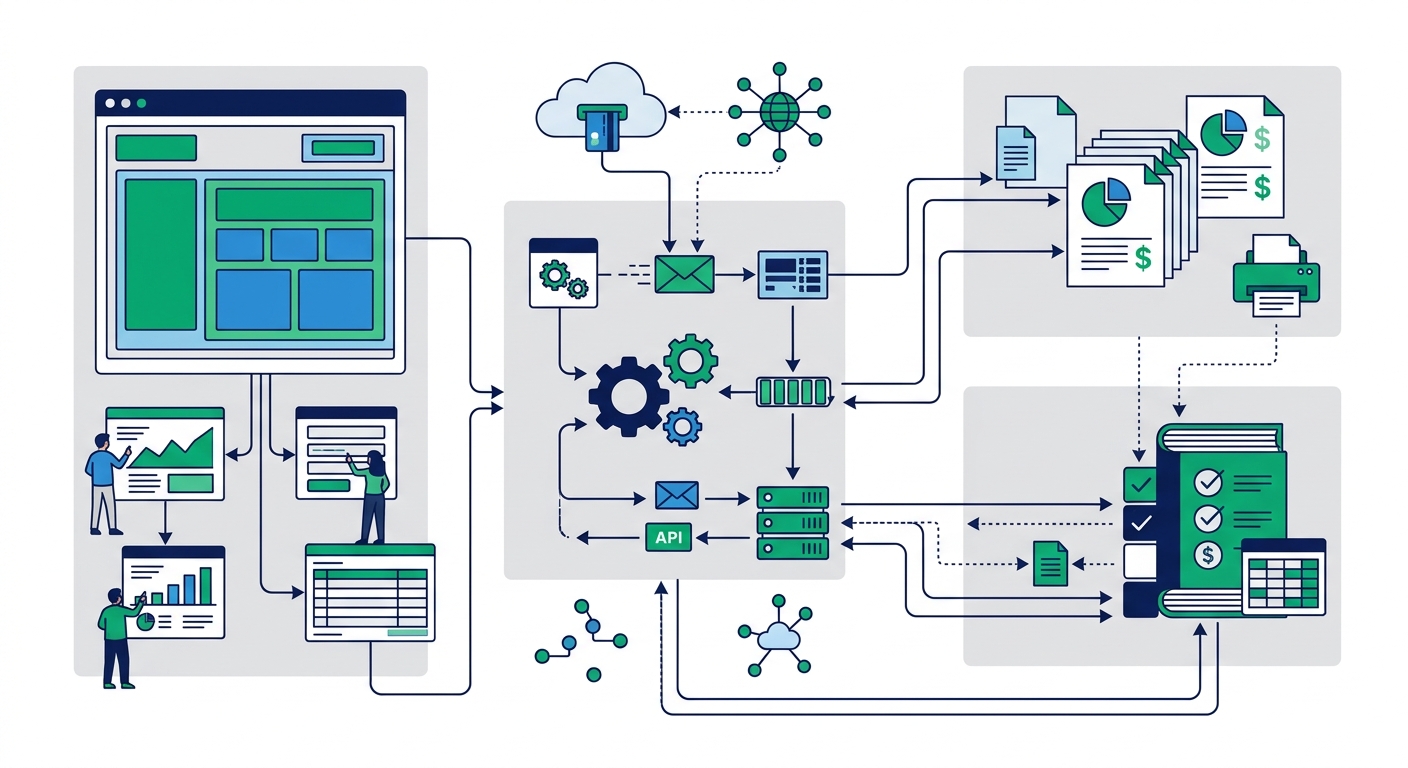
If you are planning how to build a custom gst billing software using nodejs and react, this guide provides the architectural blueprints, schema designs, and algorithmic workflows needed to ship a compliant, enterprise-grade system.
Core Architecture of Modern GST Billing Software
A resilient GST billing engine is more than a glorified CRUD tool with a printable view. It operates as a transactional ledger that balances state-specific tax laws, inventory counts, customer tax identities, and statutory filing preparations in real time.
| Subsystem | Technology Stack | Primary Responsibility |
|---|---|---|
| Frontend Layer | React, Vite, Zustand/Redux Toolkit | Dynamic item calculation, state matching, real-time totals, offline-ready counter caching. |
| Backend Service | Node.js, Express/Fastify | GSTIN lookup validation, HSN schema checks, ledger immutability, role-based workflows. |
| Data Store | PostgreSQL or MongoDB | ACID-compliant document storage for invoices, inventory ledgers, and audit revisions. |
| Reporting Engine | Node.js Worker Threads, Puppeteer/PDFKit | High-concurrency PDF invoice generation and GSTR-1/3B JSON formatting. |
Engineering teams frequently align this pipeline with broader business systems using custom software development services to ensure billing data synchronizes cleanly across enterprise supply chains.
Step 1: Model the Multi-Tenant Schema and Master GSTIN Validation
Every GST transaction hinges on the GSTIN (Goods and Services Tax Identification Number). An invalid or poorly validated GSTIN upstream results in rejected filings on the government portal.
A valid GSTIN comprises 15 alphanumeric characters structured as follows:
- Digits 1–2: State code (e.g., 27 for Maharashtra, 29 for Karnataka).
- Digits 3–12: 10-character Permanent Account Number (PAN) of the taxpayer.
- Digit 13: Entity code (order of registration within the state).
- Digit 14: Default alphabet ‘Z’.
- Digit 15: Check digit calculated via a modified Luhn algorithm.
Enforce strict structural integrity in your Node.js backend using a validation library such as Zod or Joi before any database write occurs:
const gstinRegex = /^[0-9]{2}[A-Z]{5}[0-9]{4}[A-Z]{1}[1-9A-Z]{1}Z[0-9A-Z]{1}$/;
State code extraction from the first two digits directly dictates whether an invoice incurs intra-state (CGST + SGST) or inter-state (IGST) tax, making server-side validation mandatory before saving any line item.
Step 2: Implement HSN/SAC Code Validation Logic in Node.js
In a production GST invoice generator MERN stack project, product catalogs must support both HSN (Harmonized System of Nomenclature) for physical goods and SAC (Services Accounting Code) for services. The statutory mandate requires varying code lengths based on annual turnover (typically 4 digits up to 5 crore INR, and 6 to 8 digits above 5 crore INR or for export transactions).
Your Node.js schema should enforce these boundaries while locking the applicable tax rate against historical transactions. If an admin updates a product tax slab from 18% to 12%, issued invoices must retain their historical rate.
A robust schema model includes:
- Code Format Verification: Regex checks ensuring HSN codes are numeric strings of 2, 4, 6, or 8 digits, while SAC codes are exactly 6 digits beginning with ’99’.
- Decoupled Snapshotting: Storing the line item’s applied HSN, taxable value, and tax breakdown directly on the invoice record, rather than referencing a mutable product record.
- Reverse Charge Mechanism (RCM): A Boolean flag per line item or invoice specifying whether tax liabilities shift to the buyer under Section 9(3) or 9(4).
Step 3: Build Dynamic React State for Instant Tax Calculations
Sluggish billing counters cause customer drop-offs and operational friction. A core engineering requirement of building a front-of-counter billing system is real-time client-side calculation that eliminates server round-trips for basic math while preserving exact financial precision.
When constructing the interface in React:
- Determine the Place of Supply (POS): Compare the seller state code against the buyer or delivery state code. If equal, apply
CGST = slab / 2andSGST = slab / 2. If distinct, applyIGST = slab. - Prevent Floating Point Drift: JavaScript numbers use IEEE 754 double-precision floats, which cause rounding anomalies (e.g.,
0.1 + 0.2 !== 0.3). Store and calculate monetary amounts using integer cents/paise or specialized libraries like Dinero.js or Big.js. - Statutory Rounding Rules: Under Section 170 of the CGST Act, the final tax payable and invoice total must be rounded to the nearest whole rupee (fractional paise of 50 or above rounded up, below 50 rounded down). Ensure the UI displays both the exact subtotal and the distinct
roundOffdifferential.
Step 4: Synchronize Inventory and Ledger Transactions Atomically
Building a true Node.js inventory and invoice billing application means you cannot treat invoice creation and stock management as isolated actions. If a cashier finalizes an order, warehouse quantities must decrease concurrently to prevent stock-outs.
In high-throughput environments, use database-level atomic operations or ACID transactions:
- In relational databases (PostgreSQL), run invoice generation and inventory deduction inside a single
BEGIN...COMMITblock usingFOR UPDATErow locking to avoid race conditions. - In document databases (MongoDB), execute multi-document transactions or use atomic update operators like
$incpaired with conditional guards (e.g., ensuringstockAvailable >= requestedQuantity). - For organizations running complex warehouse operations, integrating dedicated workflows via modular ERP product suites maintains stock accuracy across multi-location hubs.
Step 5: Generate Invoice PDFs with Node.js and React.js at Scale
Many teams struggle when implementing the mandate to generate invoice PDF with Node.js and React.js. Rendering PDFs by launching a full headless Chrome instance for every invoice request can exhaust container memory and trigger severe latency under load.
Evaluate these two architectural approaches based on document volume:
| Method | Pros | Cons | Best For |
|---|---|---|---|
| Headless Browser (Puppeteer) | Pixel-perfect rendering using raw HTML/CSS; supports complex multi-page layouts and CSS grid easily. | High RAM consumption (100MB+ per instance); startup latency; requires process pooling. | Low to moderate volume B2B invoices with heavily branded, complex layouts. |
| Streaming Engine (PDFKit / jsPDF) | Extremely fast; minimal memory footprint; writes directly to a Node.js writable stream. | Manual coordinate math; steep learning curve for responsive styling and tables. | High-velocity retail counters, POS terminals, and e-commerce wholesale dispatch. |
If utilizing Puppeteer, implement a browser pool (reusing a single browser instance with ephemeral tabs) rather than spinning up new processes per invoice. Ensure that static assets (logos, signatures) are loaded locally or pre-cached as Base64 strings to eliminate blocking network requests.
Step 6: Structure GSTR-1 and GSTR-3B Payloads
A true commercial-grade GST Billing Software system simplifies statutory tax reporting by transforming raw billing registers into the standardized JSON schemas required by the Goods and Services Tax Network (GSTN).
GSTR-1 Data Structuring
GSTR-1 captures outward supplies categorized into distinct statutory tables:
- B2B Invoices (Table 4): Segmented by recipient GSTIN, detailing invoice numbers, dates, values, POS, and individual tax slab breakdowns.
- B2C Large (Table 5): Inter-state supplies to unregistered buyers where invoice value exceeds 2.5 lakh INR.
- B2C Small (Table 7): Aggregated net sales by state code and tax rate for remaining consumer transactions.
- HSN Summary (Table 12): Consolidated report listing each unique HSN code, total quantity, total taxable value, and tax split (CGST, SGST, IGST).
GSTR-3B Aggregate Computation
Unlike the invoice-level granularity of GSTR-1, GSTR-3B requires aggregated tax balances for monthly self-assessment. Your Node.js backend should run automated map-reduce aggregation queries to calculate total outward taxable turnover, total integrated tax, central tax, state tax, and applicable cess for Section 3.1 summaries.
Step 7: Production Deployment, Role-Based Access, and Audit Compliance
Financial software operates under intense regulatory scrutiny. Once an invoice is registered and sent to a client, altering its values constitutes a serious compliance violation.
Implement these technical safeguards prior to release:
- Immutable Invoices: Never run
UPDATEorDELETEqueries against issued invoices. Reversals or value alterations must be executed strictly via formal Credit Notes (Section 34 of the CGST Act) or Debit Notes. - Audit Logs: Maintain an append-only ledger tracking which user generated, printed, canceled, or credited each financial transaction.
- Role-Based Access Control (RBAC): Segment operational privileges so counter cashiers can generate invoices, inventory managers can adjust incoming stock, and only accountants can access GSTR export payloads.
Teams modernizing their corporate infrastructure frequently automate these administrative handoffs by applying SaaS business automation practices, reducing friction between checkout counters and accounting personnel.
Frequently Asked Questions
Can a Node.js billing application work offline during internet outages?
Yes. By pairing React with Service Workers and an IndexedDB database (via Dexie.js or localforage), counter staff can generate bills locally. When connectivity returns, a background sync service pushes pending invoices to the Node.js backend to lock the ledger and assign sequential invoice numbers.
How are sequential invoice numbers enforced across multi-counter setups?
Sequential, non-duplicating numbering is mandatory under GST rules. To avoid race conditions across multiple active counters, maintain a dedicated counter table in your database with atomic increments, or assign distinct alphabetic series prefixes per counter (e.g., REG1-2024-001, REG2-2024-001).
What is the performance difference between MongoDB and PostgreSQL for GST billing?
PostgreSQL provides strict schema constraints, relational integrity for ledgers, and rock-solid ACID transactions. MongoDB offers rapid prototyping and document flexibility for multi-attribute product catalogs. Both work well, but PostgreSQL is widely preferred in core accounting systems due to its robust relational consistency.