
Introduction: Building Your SaaS Foundation Smartly
In the dynamic world of software, launching a new Software as a Service (SaaS) product can be both exciting and challenging. The key to success often lies not in building a feature-rich behemoth from day one, but in starting with a Minimum Viable Product (MVP). A SaaS MVP is the leanest version of your product that delivers core value to a specific target audience, allowing you to validate your idea, gather crucial user feedback, and iterate quickly without significant upfront investment.

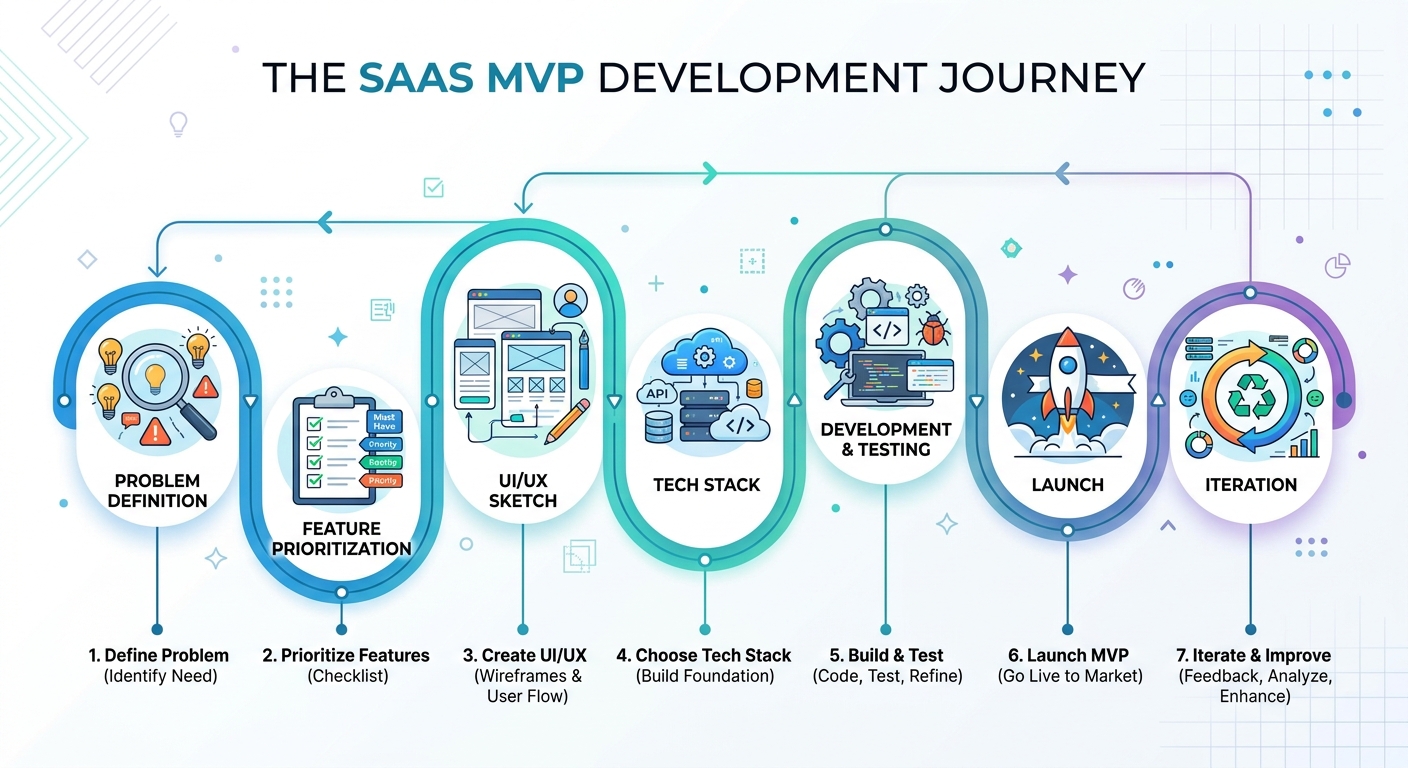
This article provides an actionable, detailed guide to SaaS MVP development, outlining 7 essential steps and the features you need to focus on. We’ll delve into technical considerations, common pitfalls, and how a strategic approach can lay the groundwork for long-term scalability and success.
Why a Strategic SaaS MVP is Crucial
The SaaS market is competitive, and resources are often limited, especially for startups and SMEs. An MVP acts as a powerful tool for market validation, risk reduction, and efficient resource allocation. It allows you to:
- Test Core Assumptions: Validate your product’s core value proposition with real users.
- Gather Early Feedback: Understand what users truly need and value, guiding future development.
- Reduce Time-to-Market: Launch faster and start generating revenue or user engagement sooner.
- Optimize Costs: Avoid over-engineering features that users might not need or want.
- Attract Investors: Demonstrate traction and product-market fit with tangible evidence.
SaaS MVP Development: 7 Essential Steps & Features
Step 1: Define the Core Problem & Target Audience
Before writing a single line of code, clearly articulate the single, most critical problem your SaaS product aims to solve. Who experiences this problem? This defines your target audience and helps create detailed user personas. Understanding their pain points, workflows, and existing solutions is paramount.
- Feature Alignment: Every feature in your MVP must directly contribute to solving this core problem for your identified audience. If it doesn’t, it’s not an MVP feature.
Step 2: Identify & Prioritize Core Features (The SaaS MVP Features List)
This is where you translate the problem into a functional solution. Focus on the absolute minimum set of features required to deliver the core value. Think of it as a single, impactful user journey.
Essential SaaS-Centric MVP Features:
- User Authentication: Secure login, registration, and password recovery.
- Basic User Profile Management: Allowing users to manage their basic information.
- Core Functionality: The single, primary use case that solves the defined problem. This is the heart of your MVP.
- Data Storage & Management: Securely storing and retrieving user-generated data relevant to the core functionality.
- Simple Dashboard/Reporting: A basic overview or status update related to the core functionality.
- Subscription/Billing Integration: Even for a free trial, having a basic framework for future monetization (e.g., a single tier).
- In-App Feedback Mechanism: A simple way for users to report bugs or suggest improvements.
- Technical Consideration: Multi-Tenancy: For SaaS, consider how your architecture will support multiple customers (tenants) from the outset. While a full multi-tenant architecture might evolve, planning for logical separation of data and resources is crucial for scalability.
Step 3: Design a User-Centric Experience (UI/UX)
An MVP doesn’t mean a poor user experience. Focus on simplicity, intuitiveness, and clarity. The UI/UX should guide users effortlessly through the core functionality, making the value immediately apparent.
- Prioritize Core User Journeys: Design the paths for the most critical tasks first, ensuring they are smooth and efficient.
- Clean & Consistent Interface: Use a consistent design language to build trust and ease of use.
Step 4: Choose the Right Technology Stack & Architecture
Selecting a robust, scalable, and maintainable tech stack is vital for a SaaS MVP. Decisions here impact future growth, security, and development velocity.
- Cloud Infrastructure: Leverage platforms like AWS or Google Cloud Platform (GCP) for their scalability, reliability, and managed services. This allows you to focus on development rather than infrastructure management.
- API Strategy: Plan for a clear API development strategy from the start. A well-defined API will facilitate future integrations, enable mobile applications (e.g., built with Flutter or React Native), and allow your product to interact with other systems.
- Containerization & CI/CD: Tools like Docker and CI/CD pipelines streamline development, testing, and deployment, ensuring consistent environments and faster iterations.
- Applizor’s Expertise: At Applizor, our cloud and DevOps expertise ensures your SaaS MVP is built on a solid foundation, ready for future scaling and continuous delivery.
Step 5: Develop, Test, and Secure Your SaaS MVP
Adopt agile development methodologies to build your MVP iteratively. This allows for flexibility and quick adjustments based on early insights.
- Thorough Testing: Implement comprehensive testing protocols, including functional, performance, and security testing. For SaaS, security is non-negotiable.
- Security First: Integrate security best practices from day one. This includes data encryption (in transit and at rest), robust access controls, regular security audits, and adherence to relevant compliance standards.
Step 6: Deploy & Launch with a Feedback Loop
Once developed and thoroughly tested, deploy your SaaS MVP to a select group of early adopters or a public beta. The launch is not the end, but the beginning of the learning phase.
- Controlled Rollout: Consider a phased launch to manage load and gather focused feedback.
- Active Feedback Collection: Implement in-app surveys, user interviews, and analytics tools to understand how users interact with your product and identify areas for improvement.
- Initial Monetization Strategy: Align your MVP features with an initial subscription model, whether it’s a free trial, a basic paid tier, or a freemium model. This helps validate your business model early on.
Step 7: Analyze, Iterate, and Plan for Future Growth
The insights gained from your MVP are invaluable. Analyze user behavior, feedback, and key performance indicators (KPIs) to inform your product roadmap.
- Data-Driven Iteration: Use data to prioritize new features and refine existing ones.
- Strategic Feature Expansion: Based on validated demand, consider integrating advanced capabilities. For instance, Applizor’s expertise in AI automation can introduce AI agents, RAG knowledge bases, or voice bots in future iterations to enhance user experience and operational efficiency. Similarly, leveraging n8n workflow automation can help streamline internal processes or integrate with third-party services as your SaaS grows.
- Scalability Planning: Continuously assess your infrastructure and architecture to ensure it can handle increasing user loads and data volumes.
Common Pitfalls in SaaS MVP Development & How to Avoid Them
Even with a clear strategy, pitfalls can derail your SaaS MVP. Here’s how to navigate them:
- Feature Bloat (Scope Creep): The most common trap. Resist the urge to add “just one more feature.” Stick to the absolute core. If it doesn’t solve the primary problem, defer it.
- Ignoring Scalability & Security: While an MVP is minimal, it shouldn’t be fragile. Neglecting multi-tenancy considerations, a robust API strategy, or foundational security measures from the start will lead to costly refactoring later.
- Poor User Feedback Mechanisms: Launching without a clear way to collect and analyze user feedback is a missed opportunity. Make it easy for users to communicate.
- Underestimating Technical Complexity: SaaS products involve complex backend systems, database management, security protocols, and infrastructure. Don’t underestimate the expertise required, especially for cloud and DevOps.
- Lack of Monetization Clarity: Even if your MVP is free, have a clear idea of how you plan to monetize later. This influences feature design and user acquisition strategies.
Partnering for Success: Why Applizor is Your Ideal SaaS MVP Development Partner
Building a successful SaaS MVP requires a blend of strategic vision, technical prowess, and agile execution. Applizor Softech LLP offers comprehensive services tailored to bring your SaaS vision to life.
Our expertise spans:
- Custom SaaS Development: From concept to deployment, we build scalable, secure, and user-centric SaaS platforms tailored to your unique business needs.
- AI Automation & Workflow Integration: Integrate intelligent AI agents, RAG knowledge bases, and n8n workflow automation to enhance your SaaS product’s capabilities and operational efficiency.
- Robust API Development: We design and implement powerful APIs that ensure your SaaS is extensible, integrable, and ready for future growth.
- Cloud & DevOps Excellence: Our team ensures your MVP is built on a resilient cloud infrastructure (AWS/GCP) with efficient CI/CD pipelines, guaranteeing scalability and reliability.
- Web & Mobile App Development: Whether it’s a web-based platform or extensions via Flutter or React Native mobile apps, we cover your entire digital presence.
By partnering with Applizor, you gain a team that understands the nuances of SaaS MVP development, helping you launch a validated product that’s poised for growth.
Conclusion
A well-executed SaaS MVP is more than just a set of features; it’s a strategic business tool. By following these 7 essential steps – from defining your core problem to continuous iteration – you can build a product that resonates with your audience, validates your business model, and sets the stage for sustainable growth. Focus on delivering undeniable core value, maintain a lean approach, and leverage expert partners to navigate the complexities of SaaS development effectively.