
Table of Contents
- What is AI Automation ROI?
- Why Quantifying AI Automation ROI is Crucial for SMEs and Startups
- The 7 Proven Steps to Quantify AI Automation ROI
- Step 1: Define Clear Objectives and Scope
- Step 2: Baseline Current Costs and Performance
- Step 3: Identify and Quantify Tangible Benefits
- Step 4: Assess Intangible Benefits and Assign Proxy Values
- Step 5: Calculate Total AI Automation Investment
- Step 6: Compute the AI Automation ROI
- Step 7: Monitor, Measure, and Optimize Continuously
- Real-World Applications of AI Automation for Business
- FAQs About AI Automation ROI
- Ready to Unlock the Value of AI Automation?
In today’s fast-evolving business landscape, Artificial Intelligence (AI) automation is no longer a futuristic concept but a strategic imperative. From streamlining repetitive tasks to empowering intelligent decision-making, AI offers transformative potential. However, for startup founders, SME owners, and IT leaders, the critical question remains: how do you measure the actual return on investment (ROI) from these advanced technologies?
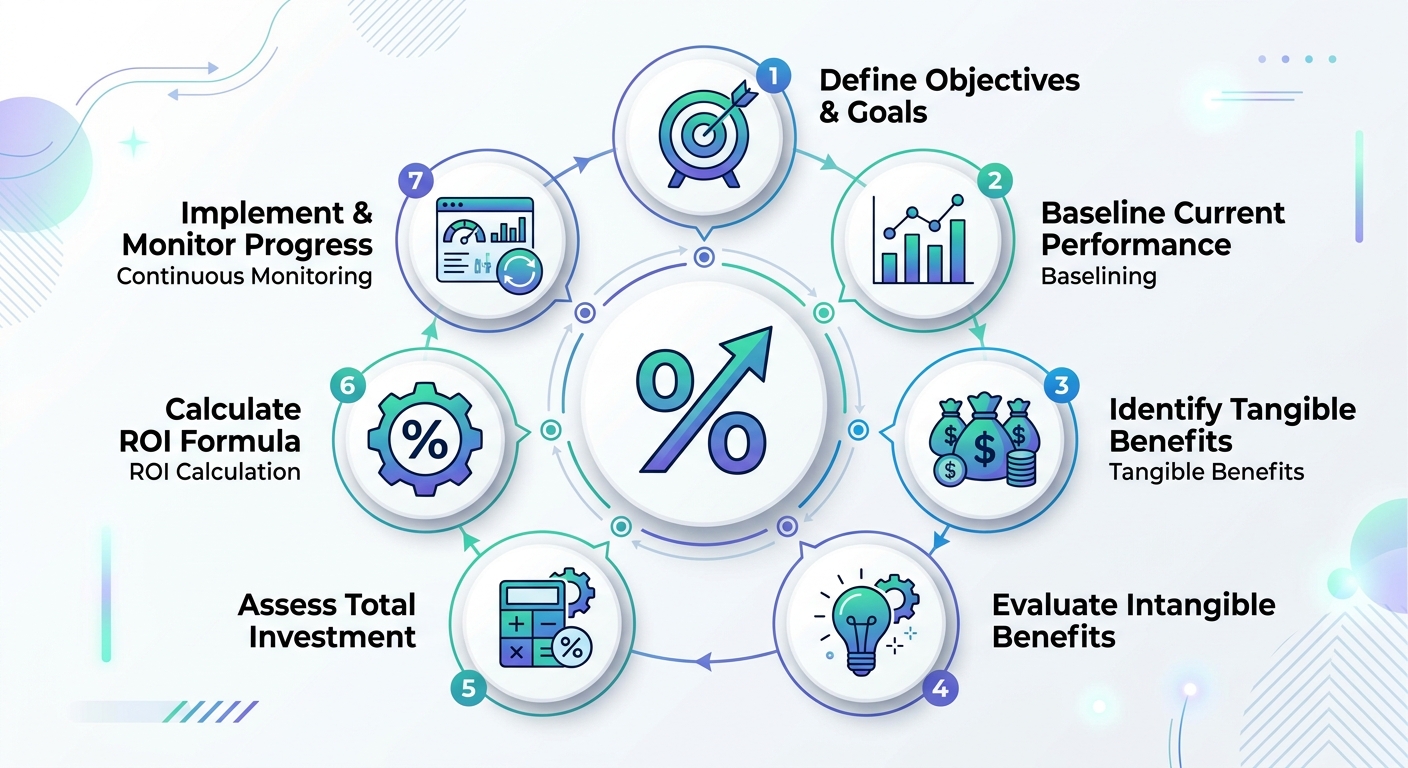
Investing in AI automation, whether it’s a custom ERP system, n8n workflow, or specialized AI agents, requires a clear justification. This guide provides a practical, step-by-step framework to help you quantify the business value of AI automation, ensuring your investments are strategic and yield measurable results.
What is AI Automation ROI?
AI automation ROI (Return on Investment) is a metric that measures the financial benefits gained from an AI automation initiative relative to its costs. It helps businesses understand the profitability and efficiency improvements achieved by deploying AI-powered solutions. Unlike traditional software, AI automation often involves both direct cost savings and significant intangible benefits, making a comprehensive ROI calculation essential for true investment justification.
Why Quantifying AI Automation ROI is Crucial for SMEs and Startups
For small and medium-sized enterprises (SMEs) and startups, every investment decision carries significant weight. Limited budgets and resources mean that technology adoption must deliver clear, demonstrable value. Quantifying AI automation ROI provides:
- Investment Justification: A clear business case for stakeholders, investors, and internal teams.
- Strategic Prioritization: Helps identify which AI projects will deliver the most impact.
- Risk Mitigation: Reduces the uncertainty associated with new technology adoption.
- Performance Measurement: Establishes benchmarks to track success and optimize future initiatives.
- Competitive Advantage: Enables smarter, data-driven decisions to outpace competitors.
This is especially true when considering custom AI automation solutions, which are tailored to your unique business processes and can offer a distinct edge.
The 7 Proven Steps to Quantify AI Automation ROI
Calculating your AI automation ROI doesn’t have to be a complex endeavor. By following these seven steps, you can build a robust case for your AI investments and track their success.
Step 1: Define Clear Objectives and Scope
Before you can measure success, you need to know what success looks like. Clearly define the specific business problem you aim to solve with AI automation. Use SMART (Specific, Measurable, Achievable, Relevant, Time-bound) goals.
- Example Objective: "Automate customer support email responses for FAQs to reduce agent workload by 30% within 6 months."
- Scope: Identify the specific processes, departments, or tasks that the AI automation will impact. Are you automating a part of your custom ERP workflow, a specific customer interaction via a voice bot, or data extraction using an AI agent?
Step 2: Baseline Current Costs and Performance
This is a critical pre-investment step. To demonstrate improvement, you need a clear understanding of your current state. Gather data on:
- Labor Costs: How much time do employees spend on the tasks targeted for automation? Calculate their hourly cost (salary + benefits).
- Error Rates: What is the frequency and cost of human errors in the current process?
- Processing Time: How long does it take to complete the task manually?
- Resource Consumption: Are there any other direct costs (e.g., software licenses, infrastructure, materials) associated with the current manual process?
- Throughput: How many transactions or tasks are processed within a given period?
For instance, if you’re considering AI agents to process invoices, baseline the average time per invoice, the number of errors, and the associated labor cost.
Step 3: Identify and Quantify Tangible Benefits
Tangible benefits are direct, measurable financial gains. These often fall into three categories:
-
Cost Savings:
- Reduced Labor Costs: Calculate the reduction in FTEs (Full-Time Equivalents) or reallocation of employee time to higher-value tasks. (e.g., 20 hours/week saved * $25/hour = $500/week).
- Lower Operational Costs: Savings from reduced errors, less rework, or optimized resource usage.
- Infrastructure Savings: If automation reduces reliance on legacy systems or physical resources.
-
Revenue Generation:
- Increased Sales: Automation of sales processes (e.g., lead nurturing via AI-powered CRM) can lead to higher conversion rates.
- New Business Opportunities: AI can uncover market insights or enable new service offerings.
-
Efficiency Gains:
- Faster Processing: Reduced cycle times for tasks (e.g., invoice processing, order fulfillment).
- Increased Throughput: Ability to handle a higher volume of work without proportional cost increases.
Step 4: Assess Intangible Benefits and Assign Proxy Values
Many significant benefits of AI automation aren’t immediately reflected on a balance sheet but are crucial for long-term success. These include:
-
Improved Employee Satisfaction & Retention: Automating mundane tasks frees employees for more engaging, strategic work. Assign a proxy value by estimating the cost of employee turnover or the productivity gain from higher morale.
-
Enhanced Customer Experience: Faster service, personalized interactions (e.g., via RAG knowledge bases or voice bots), and 24/7 availability. Quantify by looking at improved customer retention rates, increased customer lifetime value (CLTV), or reduced customer service costs.
-
Better Data Insights & Decision Making: AI can process vast amounts of data to provide actionable insights. Assign a value by estimating the impact of better decisions on revenue, cost reduction, or risk mitigation.
-
Competitive Advantage: Being an early adopter or having superior operational efficiency can differentiate your business. This is harder to quantify but can be linked to market share growth or premium pricing.
-
Scalability and Agility: AI automation allows your operations to scale without linear increases in manual labor, making your business more adaptable to market changes. Consider the cost savings of avoiding hiring surges or the revenue potential from rapid market response.
Step 5: Calculate Total AI Automation Investment
Sum up all costs associated with your AI initiative. This includes both upfront and ongoing expenses:
- Development & Implementation Costs: This includes custom software development (for ERP/CRM or specific AI agents), integration with existing systems, n8n workflow automation setup, and data preparation.
- Software & Licensing: Any subscription fees for AI platforms, APIs, or tools.
- Infrastructure: Costs for cloud services (AWS, GCP), servers, storage, and networking.
- Training: Costs to train employees on new AI tools and processes.
- Maintenance & Support: Ongoing costs for system upkeep, updates, and technical support.
- Opportunity Costs: The value of alternatives you forgo by choosing this particular investment.
- Data Costs: Costs associated with acquiring, cleaning, and preparing data for AI models.
Step 6: Compute the AI Automation ROI
Once you have your total benefits and total costs, you can calculate the ROI using the following formula:
AI Automation ROI = ((Total Tangible Benefits + Total Quantified Intangible Benefits) - Total Investment Costs) / Total Investment Costs * 100%
Additionally, consider:
- Payback Period: How long will it take for the accumulated benefits to cover the initial investment?
- Net Present Value (NPV): Useful for longer-term projects, NPV accounts for the time value of money.
Step 7: Monitor, Measure, and Optimize Continuously
ROI calculation isn’t a one-time event. AI systems are dynamic, and their performance can evolve. Implement a system to continuously track the KPIs you defined in Step 1 and the benefits identified in Steps 3 and 4.
- Dashboards: Create dashboards to visualize key metrics (e.g., tasks processed, error rates, time saved, customer satisfaction scores).
- Regular Reviews: Schedule periodic reviews to assess performance against initial objectives.
- Iterative Optimization: Use insights from continuous monitoring to fine-tune your AI models, workflows, or processes for even greater efficiency and ROI.
- Integrate with BI Tools: Connect your AI automation data with existing business intelligence (BI) tools for a holistic view of performance.
Real-World Applications of AI Automation for Business
At Applizor Softech LLP, we see these steps applied across various industries and business sizes. For instance:
- Custom ERP/CRM Automation: Integrating AI into a custom ERP solution can automate supply chain management, financial reporting, or customer segmentation, leading to significant efficiency gains and better strategic planning.
- N8n Workflow Automation: Using n8n to connect disparate systems and automate data flows can drastically reduce manual data entry and improve data accuracy across marketing, sales, and operations.
- AI Agents for Specific Tasks: Deploying AI agents for tasks like document processing, customer inquiry routing, or lead qualification can free up human resources for more complex work.
- RAG Knowledge Bases and Voice Bots: Implementing advanced conversational AI for customer support can reduce response times, improve first-contact resolution, and enhance overall customer satisfaction.
These are just a few examples of how AI automation solutions for small businesses and startups can drive measurable value.
FAQs About AI Automation ROI
How long does it take to see ROI from AI automation?
The payback period for AI automation varies significantly based on the complexity of the solution, the initial investment, and the specific processes being automated. Simple workflow automations (e.g., via n8n) might show ROI within months, while complex custom AI agents or ERP integrations could take 1-2 years. Continuous monitoring (Step 7) is key to tracking this.
What are common pitfalls in calculating AI ROI?
Common pitfalls include underestimating implementation costs, failing to account for ongoing maintenance and training, neglecting to quantify intangible benefits, using inaccurate baseline data, and not continuously tracking performance after deployment. Focusing solely on cost savings and ignoring revenue generation or customer experience improvements is another frequent error.
Can AI automation benefit small businesses with limited budgets?
Absolutely. AI automation is increasingly accessible and scalable for small businesses. Solutions like n8n for workflow automation or targeted AI agents for specific tasks can deliver significant ROI without requiring massive upfront investments. The key is to start with well-defined, high-impact problems and leverage partners who specialize in tailored, cost-effective solutions.
Ready to Unlock the Value of AI Automation?
Quantifying the ROI of AI automation is not just about numbers; it’s about making informed strategic decisions that propel your business forward. By following these 7 proven steps, you can confidently justify your AI investments and ensure they deliver tangible, measurable value.
Whether you’re exploring custom ERP/CRM development, advanced AI agents, n8n workflow automation, or intelligent voice bots, understanding your potential AI automation ROI is the first step towards a more efficient, innovative, and profitable future. Connect with Applizor Softech LLP to explore how tailored AI solutions can transform your business with a clear path to measurable returns.