
Introduction: Navigating the Future of SME Supply Chains
For Small and Medium-sized Enterprises (SMEs), managing a supply chain can feel like a constant balancing act. From unpredictable demand and inventory bottlenecks to rising operational costs and complex logistics, the challenges are numerous. While large corporations pour resources into advanced technologies, many SMEs believe cutting-edge solutions like Artificial Intelligence (AI) are out of reach.
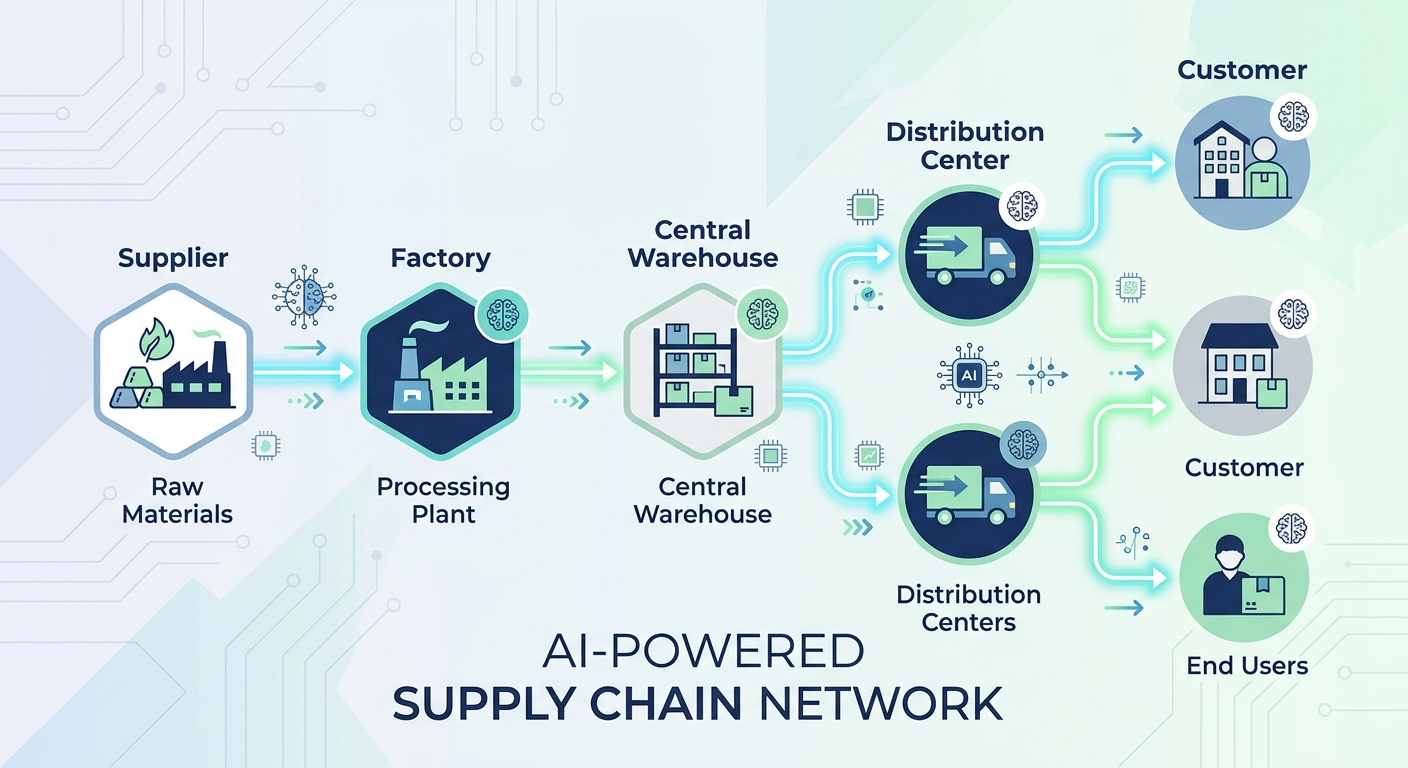
This couldn’t be further from the truth. AI supply chain automation is no longer just for the enterprise giants. With the right strategies, SMEs can leverage AI to streamline operations, reduce costs, enhance resilience, and gain a competitive edge. This article provides a practical, step-by-step framework for SMEs to adopt AI automation in their supply chain, considering common constraints like budget and technical skill. We’ll explore seven ultimate strategies, highlighting how Applizor Softech LLP’s custom ERP, n8n automation, and AI agents can be integrated into your journey.
Why AI Supply Chain Automation is a Game-Changer for SMEs
The traditional, manual approach to supply chain management is prone to human error, slow decision-making, and limited visibility. For SMEs, these inefficiencies directly impact profitability and growth potential. AI offers a powerful alternative by:
- Improving Forecast Accuracy: AI algorithms can analyze vast datasets (historical sales, market trends, weather, social media sentiment) to predict demand with greater precision, reducing overstocking and stockouts.
- Optimizing Operations: From warehouse layouts to delivery routes, AI identifies the most efficient paths, cutting down on time and resources.
- Enhancing Resilience: By identifying potential disruptions early, AI allows SMEs to pivot quickly, mitigating risks and ensuring business continuity.
- Reducing Costs: Automation minimizes manual labor, optimizes inventory levels, and improves logistics efficiency, leading to significant cost savings.
- Boosting Customer Satisfaction: Faster deliveries, fewer errors, and proactive communication lead to happier customers.
Common Challenges for SMEs in Adopting AI (and How to Overcome Them)
Before diving into strategies, let’s address the hurdles:
- Budget Constraints: AI solutions don’t have to break the bank. Focus on modular, scalable solutions and start with pilot projects that offer clear ROI. Applizor specializes in AI automation solutions for small business, designed for cost-effectiveness.
- Lack of Technical Expertise: You don’t need an in-house team of data scientists. Partnering with a software engineering firm like Applizor provides access to the necessary skills for implementation and ongoing support.
- Data Availability and Quality: Many SMEs have fragmented data. The first step is often consolidating existing data, even if imperfect, and then improving its quality over time. Applizor’s custom ERP solutions can help centralize your data.
- Fear of Complexity: Start simple. Focus on automating one critical pain point, demonstrate success, and then expand. AI is a journey, not a switch.
7 Ultimate Strategies for AI Supply Chain Automation in SMEs
1. Enhanced Demand Forecasting with AI
Strategy: Move beyond basic spreadsheets to leverage AI for more accurate predictions of customer demand, minimizing waste and maximizing sales opportunities.
How SMEs can implement:
- Start with existing data: Begin by feeding your historical sales data, promotional calendars, and seasonal trends into an AI model.
- Integrate external factors: As you scale, incorporate external data like local events, weather patterns, or economic indicators.
Applizor’s Edge: Our custom AI agents can be trained on your specific sales history and market data, integrating directly with your existing retail/POS billing or Applizor ERP to provide predictive insights. This allows even small businesses to benefit from sophisticated forecasting without needing complex infrastructure.
2. Optimized Inventory Management
Strategy: Use AI to determine optimal stock levels, automate reordering, and reduce carrying costs while preventing costly stockouts.
How SMEs can implement:
- Categorize inventory: Identify fast-moving vs. slow-moving items to apply different AI-driven reorder rules.
- Automate reorder points: Set up triggers based on predicted demand and lead times.
Applizor’s Edge: Our dedicated inventory management product, or a custom module within Applizor ERP, can integrate AI components. Furthermore, n8n workflow automation can connect your inventory system with suppliers, automatically generating purchase orders when stock levels hit predefined thresholds, based on AI-driven forecasts.
3. Automated Procurement and Supplier Management
Strategy: Streamline the purchasing process, from vendor selection and order placement to invoice processing, using AI and automation.
How SMEs can implement:
- Automate repetitive tasks: Use rules-based automation for routine purchase orders.
- AI for supplier evaluation: Over time, AI can help analyze supplier performance (delivery times, quality, pricing) to recommend optimal choices.
Applizor’s Edge: Applizor’s custom ERP and CRM solutions can centralize supplier data. n8n workflow automation can be configured to automate purchase order generation, send automated reminders, and even process invoices by integrating with accounting systems, significantly reducing manual effort and errors.
4. Predictive Maintenance for Logistics & Assets
Strategy: Employ AI to predict equipment failures and schedule maintenance proactively, minimizing downtime and extending asset lifespan.
How SMEs can implement:
- Collect basic data: Start by tracking usage hours, fuel consumption, or simple sensor readings from key equipment (e.g., delivery vehicles, warehouse machinery).
- Anomaly detection: AI can identify unusual patterns in this data that might indicate impending failure.
Applizor’s Edge: We can develop custom AI agents that monitor operational data from your machinery or fleet. Combined with n8n automation, these agents can trigger alerts to maintenance teams or schedule service appointments automatically when anomalies are detected, preventing costly breakdowns and ensuring smooth operations.
5. Streamlined Warehouse Operations with AI
Strategy: Optimize warehouse layouts, picking routes, and task assignments to improve efficiency and reduce operational costs.
How SMEs can implement:
- Data-driven layout analysis: Use historical order data to identify frequently accessed items and optimize their placement.
- AI-assisted task assignment: For smaller teams, AI can help assign picking tasks based on location and urgency.
Applizor’s Edge: Integrating with Applizor ERP, AI models can analyze inventory movement patterns to suggest optimal storage locations and picking paths. While full robotics might be a future step, even simple AI-driven insights can significantly improve manual or semi-automated warehouse processes.
6. Real-time Visibility and Anomaly Detection
Strategy: Gain end-to-end visibility into your supply chain and use AI to detect and alert you to potential issues before they escalate.
How SMEs can implement:
- Centralize data: Consolidate data from various touchpoints (orders, shipments, inventory) into a single dashboard.
- Set up alerts: Configure AI agents to monitor key metrics and notify you of deviations (e.g., delayed shipments, unexpected demand spikes).
Applizor’s Edge: Our custom software development services can build dashboards that provide real-time insights across your supply chain. Applizor’s AI agents can continuously monitor these data streams, identifying anomalies and triggering instant alerts via n8n automation to relevant stakeholders, allowing for proactive problem-solving.
7. Intelligent Customer Service & Communication
Strategy: Leverage AI to automate routine customer inquiries and provide instant, accurate information regarding order status, delivery, and product availability.
How SMEs can implement:
- Implement a knowledge base: Create a searchable repository of common questions and answers.
- Deploy simple chatbots/voice bots: Start with AI-powered bots that can answer FAQs and provide order updates.
Applizor’s Edge: Applizor offers RAG knowledge bases and voice bots that can be integrated with your customer service channels. These AI tools can provide instant, accurate responses to customer queries, freeing up your team for more complex issues and enhancing overall customer satisfaction.
Implementing AI in Your SME Supply Chain: A Step-by-Step Framework
Embracing AI in supply chain for small business doesn’t require a massive overhaul. Here’s a practical framework:
- Assess Current State & Identify Pain Points: Where are your biggest bottlenecks, inefficiencies, or cost drains? Start with one clear problem you want to solve.
- Start Small with a Pilot Project: Don’t try to automate everything at once. Pick one strategy (e.g., demand forecasting for a single product line, or automating purchase orders for one supplier) and focus on demonstrating its value.
- Leverage Existing Data: You likely have more data than you think. Start with your sales records, inventory logs, and supplier invoices. Data quality can improve over time.
- Choose Scalable, Modular Solutions: Opt for solutions that can grow with your business and integrate with your existing systems. Applizor’s custom software development ensures modularity and scalability.
- Partner for Expertise: Don’t go it alone. A partner like Applizor can provide the AI engineering, automation expertise, and cloud/DevOps support to implement and manage these solutions effectively.
- Train Your Team: AI is a tool. Ensure your employees understand its benefits and how to use the new systems. Change management is crucial.
- Iterate and Expand: Once your pilot is successful, learn from it, refine your approach, and then gradually expand AI automation to other areas of your supply chain.
Why Choose Applizor for Your AI Supply Chain Journey?
Applizor Softech LLP understands the unique challenges and opportunities for SMEs. We offer a comprehensive suite of services tailored to bring the power of AI to your supply chain:
- Custom Software Development: We build bespoke ERP, CRM, and SaaS solutions that fit your exact needs, integrating AI components seamlessly.
- AI Automation Expertise: From custom AI agents for predictive analytics to n8n workflow automation for connecting disparate systems, we design intelligent solutions that deliver tangible results.
- Cloud & DevOps: We ensure your AI solutions are hosted on scalable, secure cloud infrastructure (AWS/GCP) with robust CI/CD pipelines for continuous improvement.
- Holistic Approach: Beyond AI, we offer web and mobile app development, technical SEO, and digital growth strategies, ensuring your entire digital ecosystem supports your business goals.
With Applizor, you gain a partner committed to helping your SME achieve business automation and supply chain excellence.
Conclusion: Embrace the Future of Your Supply Chain
AI supply chain automation is no longer a luxury but a strategic imperative for SMEs looking to thrive in a dynamic global market. By adopting these seven strategies, focusing on low-cost entry points, and leveraging scalable solutions, you can transform your operations, reduce costs, and build a more resilient and responsive supply chain. The journey begins with a single step – identifying your biggest pain point and exploring how AI can offer a practical, impactful solution. Don’t let misconceptions hold you back; the future of efficient logistics is here, and it’s accessible to your SME.
FAQs on AI Supply Chain Automation for SMEs
Q1: Is AI supply chain automation too expensive for a small business?
A1: Not necessarily. Many AI solutions for SMEs focus on modularity and cloud-based services, offering lower upfront costs and pay-as-you-go models. Starting with a pilot project to automate one specific process can provide significant ROI, making further investment justifiable. Applizor focuses on scalable and cost-effective solutions for SMEs.
Q2: Do I need a lot of technical expertise to implement AI in my supply chain?
A2: While AI involves complex technology, you don’t need to be an expert in-house. Partnering with a specialized firm like Applizor provides you with access to the necessary AI engineering, data science, and automation expertise. We handle the technical implementation, allowing your team to focus on their core business.
Q3: What kind of data do I need for AI supply chain automation?
A3: You can start with your existing operational data: historical sales, inventory levels, order fulfillment times, supplier lead times, and shipping records. The more consistent and clean your data, the better. Even imperfect data can provide initial insights, and systems like Applizor ERP can help centralize and improve data quality over time.
Q4: How quickly can an SME see results from AI supply chain automation?
A4: The timeline varies depending on the complexity of the chosen strategy and the initial data readiness. However, by focusing on specific pain points with a pilot project (e.g., automating purchase orders or improving demand forecasting for a key product), SMEs can often see tangible benefits and ROI within a few months, demonstrating the value for further expansion.