
For an early-stage startup, commercial CRM platforms present a predictable paradox: they begin as an easy fix but quickly turn into an expensive bottleneck. Per-seat licensing fees scale relentlessly as teams grow, while out-of-the-box workflows force teams to adapt their proprietary sales processes to rigid software constraints. When off-the-shelf software requires countless brittle plugins just to sync customer data with your core product, building proprietary software transitions from a luxury into an architectural necessity.
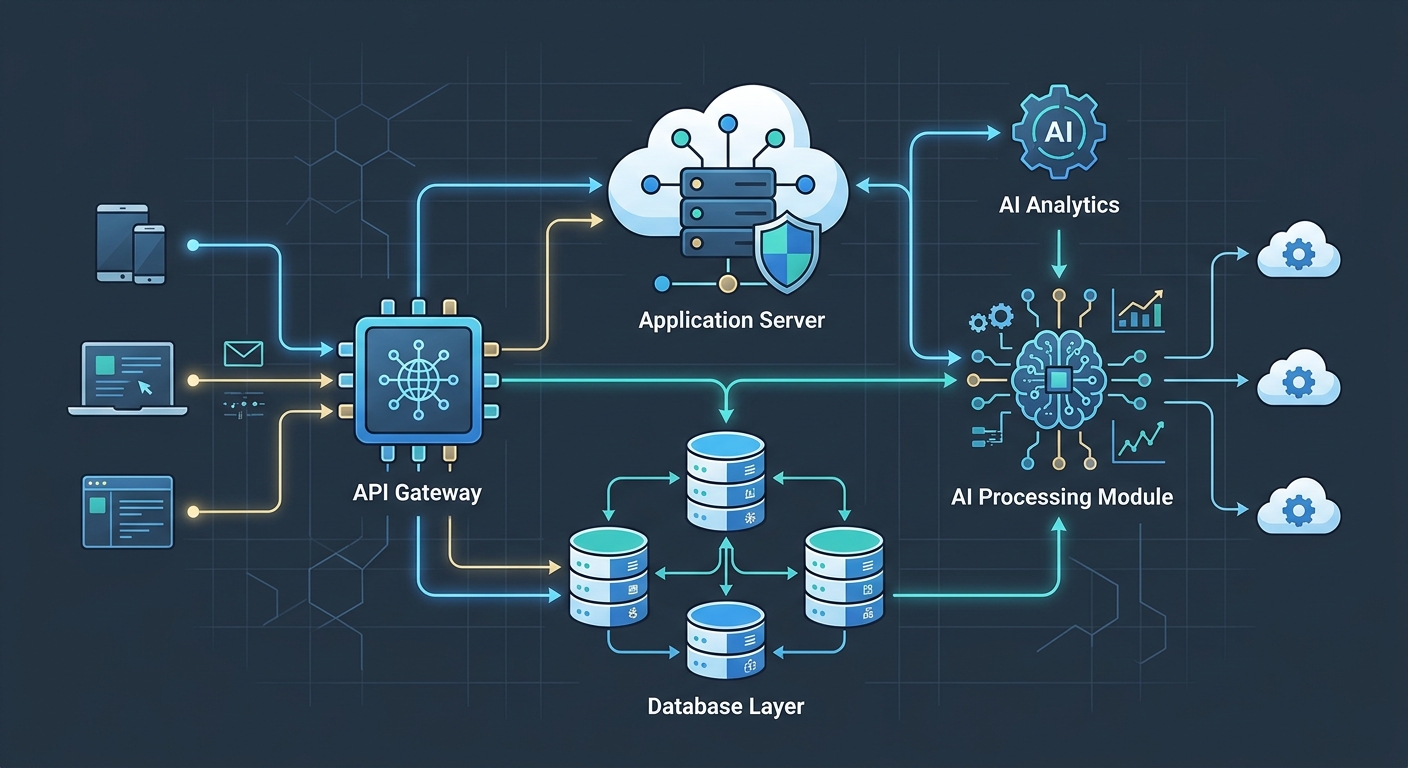
Building custom crm software allows startups to own their core intellectual property, customize sales pipelines around exact customer journeys, and unify customer data without arbitrary vendor limits. Below is a comprehensive, technical roadmap covering how engineering leaders and technical founders can plan, architect, and deploy a scalable custom CRM system.
1. Define Core Domain Entities and Multi-Tenant Data Architecture
The foundation of any resilient custom CRM development guide begins at the persistence layer. A frequent failure mode in early-stage CRM development is designing tables solely around immediate contact management, failing to accommodate organizational hierarchies or account-level partitioning.
For startups planning a B2B SaaS product or managing distinct operational units, a multi-tenant schema with shared-database, isolated-row architecture provides the most cost-effective scalability. Using PostgreSQL Row Level Security (RLS), you can enforce tenant isolation directly at the database level rather than relying solely on application-level filters.
A production-ready data model should establish clear boundaries between core entities:
- Tenants/Organizations: The top-level account partition carrying subscription tier, regional metadata, and global configuration flags.
- Users: Team members assigned granular Role-Based Access Control (RBAC) scopes (such as admin, sales representative, or account executive).
- Contacts & Accounts: Distinct tables where individual contacts are mapped to company accounts, supporting one-to-many relationships to track historical parent-company transitions.
- Pipelines & Deals: A polymorphic deal engine allowing custom stages, deal values, currency specifications, and expected close dates.
- Activities & Audit Logs: An append-only ledger capturing meetings, call logs, emails, notes, and field mutation histories for operational transparency.
Adopting PostgreSQL schemas with native JSONB columns for custom fields enables rapid iteration during product validation while retaining the performance and relational integrity of indexed SQL keys.
2. Architect an API-First Integration Engine to Eliminate Technical Debt
A CRM does not exist in isolation. It acts as an operational hub connecting transactional billing, marketing inbound funnels, and communication rails. When engineering teams build a CRM system for startups without an API-first approach, third-party integrations quickly result in fragile, point-to-point code.
Adopt OpenAPI-compliant REST or GraphQL interfaces for your internal services. To safely scale bidirectional syncs with communication channels, accounting systems, and marketing platforms, design an asynchronous, event-driven integration layer using tools like webhooks and idempotent consumer workers.
- Idempotency Keys: Ensure every webhook ingestion endpoint (such as Stripe payment updates or transactional email events) requires a unique idempotency key to prevent duplicate record processing during network retries.
- Dead Letter Queues (DLQ): Route failed sync attempts to a dedicated queue with exponential backoff rather than stalling the primary processing thread.
- Unified Event Bus: Emit state change events (e.g.,
deal.won,contact.created) to downstream microservices or internal automation engines via a lightweight message broker.
For engineering teams balancing rapid feature delivery with robust reliability, working with specialized custom software development services ensures integration boundaries remain cleanly decoupled from day one.
3. Embed AI Automation Agents and RAG Knowledge Bases
In 2026, a CRM must do more than store static records; it must actively interpret context and reduce administrative friction. Rather than retrofitting basic language model prompts over manual text fields, modern proprietary CRM architecture incorporates Retrieval-Augmented Generation (RAG) and event-driven automation directly into the workflow.
By integrating a dedicated RAG knowledge base, your custom CRM can index unstructured documentation, past email threads, support tickets, and sales battlecards into a vector store (such as PostgreSQL with the pgvector extension). When an account executive reviews a deal, the system retrieves relevant historical interactions and surfaces actionable summaries in real time.
Furthermore, internal workflows can be orchestrated using dedicated automation engines. Utilizing platforms like n8n documentation outlines, developers can bind CRM webhook triggers to autonomous agents that handle:
- Automated lead enrichment by parsing incoming domain data and querying industry registries.
- Real-time sentiment scoring on incoming customer emails to trigger proactive escalations.
- Synthesizing multi-stakeholder email threads into concise account summaries directly on the deal board.
Implementing targeted AI automation software development services allows your CRM to convert raw conversational context into structured database entities without manual human entry.
4. Build a High-Velocity, Role-Adaptive User Interface
A frequent reason off-the-shelf platforms fail inside high-growth startups is user interface fatigue. Sales reps spend hours clicking through nested configuration menus simply to update a contact status. A proprietary frontend gives you complete control over user velocity.
When planning how to build custom crm software for startups, prioritize keyboard-first navigation, optimistic UI updates, and responsive rendering:
- Component Reusability: Build the interface using modular web frameworks (such as React) combined with robust table packages capable of virtualizing thousands of rows without browser lag.
- Mobile Parity: Sales representatives and field managers often require real-time deal access away from a desk. Utilize cross-platform frameworks like Flutter or React Native to ship lightweight mobile companions that share validation logic with your core web application.
- Custom Dashboards by Role: Render contextual views dynamically. A SDR needs a high-cadence calling and sequencing queue; an account executive needs a multi-stage visual pipeline; an operations leader requires pipeline health metrics and velocity analytics.
5. Provision Cost-Effective Cloud Infrastructure (AWS / GCP)
Cloud infrastructure costs can spiral if a custom CRM is provisioned on over-specced, always-on enterprise instances. Startups need high availability, automatic scaling during business hours, and minimal baseline costs during non-peak windows.
According to official cloud architecture guidelines in the AWS Documentation, startups can achieve enterprise-grade isolation and elasticity without heavy infrastructure overhead by leveraging containerized microservices and serverless infrastructure:
| Component | Recommended Cloud Architecture (AWS / GCP) | Cost & Scalability Benefit |
|---|---|---|
| Compute Layer | AWS ECS on Fargate or GCP Cloud Run | Zero infrastructure management; scales down automatically during off-hours, charging only for executed container tasks. |
| Database Tier | Amazon RDS for PostgreSQL or GCP Cloud SQL | Automated backups, multi-AZ failover capability, and managed storage scaling with minimal maintenance overhead. |
| Connection Pooling | PgBouncer / AWS RDS Proxy | Prevents database connection exhaustion caused by ephemeral application containers or bursty webhook traffic. |
| Object Storage | Amazon S3 / Google Cloud Storage | Scalable, low-cost persistence for attachments, contracts, audio call recordings, and generated invoices. |
| Caching & Queues | Amazon ElastiCache (Redis) / Cloud Memorystore | Sub-millisecond session caching and reliable message brokering for background job queues. |
6. Enforce Enterprise-Grade Security and Compliance Controls
Even early-stage companies handle highly sensitive client financial and personal data. Treating security as an afterthought creates substantial liability during enterprise procurement reviews and investor due diligence.
A defensible custom CRM architecture incorporates strict controls across multiple layers:
- Data Encryption: Enforce TLS 1.3 for all data in transit and AES-256 for all block and object storage at rest.
- Granular RBAC and Scopes: Avoid simple binary administrator roles. Establish fine-grained permission sets (e.g.,
deals:read:team,contacts:export:none) to prevent unauthorized mass data exports. - Immutable Audit Trails: Record all destructive actions (such as contact deletions, lead reassignments, and permission changes) to an append-only log containing user IDs, timestamps, and IP addresses.
- Data Residency Readiness: If operating internationally or servicing regional enterprise clients, design database schemas to support localized data hosting regions to comply with data protection regulations.
7. Implement Continuous Integration and Phased Rollouts
Deploying a custom CRM requires minimizing friction during the transition away from existing spreadsheets or legacy systems. A big-bang launch often introduces adoption resistance and edge-case disruptions.
Structure your release through disciplined continuous integration and deployment (CI/CD) pipelines:
- Automated Testing: Implement high-coverage unit tests for critical business logic (such as commission calculations, routing algorithms, and deal stage validation) alongside end-to-end browser tests for core conversion funnels.
- Phased Data Migration: Build idempotent Extract, Transform, Load (ETL) scripts that pull legacy records, validate formatting constraints, and clean historical data before inserting records into the new schema.
- Feature Flagging: Deploy updates behind dynamic feature flags. This allows product teams to test new custom pipelines with a single internal sales pod before rolling them out company-wide.
- Internal Observability: Configure application performance monitoring (APM) and structured error logging to monitor API latencies, query execution times, and background queue bottlenecks in real time.
Custom CRM Software: Key Strategic Trade-Offs
Deciding to develop internal software is a long-term strategic commitment. Reviewing key trade-offs helps teams validate whether a build approach aligns with their operational goals:
| Evaluation Factor | Off-the-Shelf Commercial CRM | Custom CRM Software |
|---|---|---|
| Initial Time-to-Market | Rapid initial setup (days to weeks) | Longer initial development (months to MVP) |
| Recurring Overhead | High per-user seat pricing that escalates yearly | Low infrastructure hosting costs; independent of user count |
| Workflow Flexibility | Constrained to vendor APIs, plugins, and fixed schemas | Complete architectural freedom to match proprietary business models |
| Data Ownership & IP | Customer data lives within a third-party walled garden | Full intellectual property ownership and control over data residency |
| Maintenance Obligation | Managed entirely by the vendor | Requires dedicated internal or partner engineering support |
Next Steps for Your Startup’s CRM Roadmap
Building tailored CRM software allows fast-moving startups to convert internal workflows into proprietary competitive advantages. By beginning with a resilient multi-tenant database design, isolating integrations behind clean API contracts, and embedding AI automation directly into pipeline stages, engineering teams can build an operational platform that scales efficiently for years to come.