
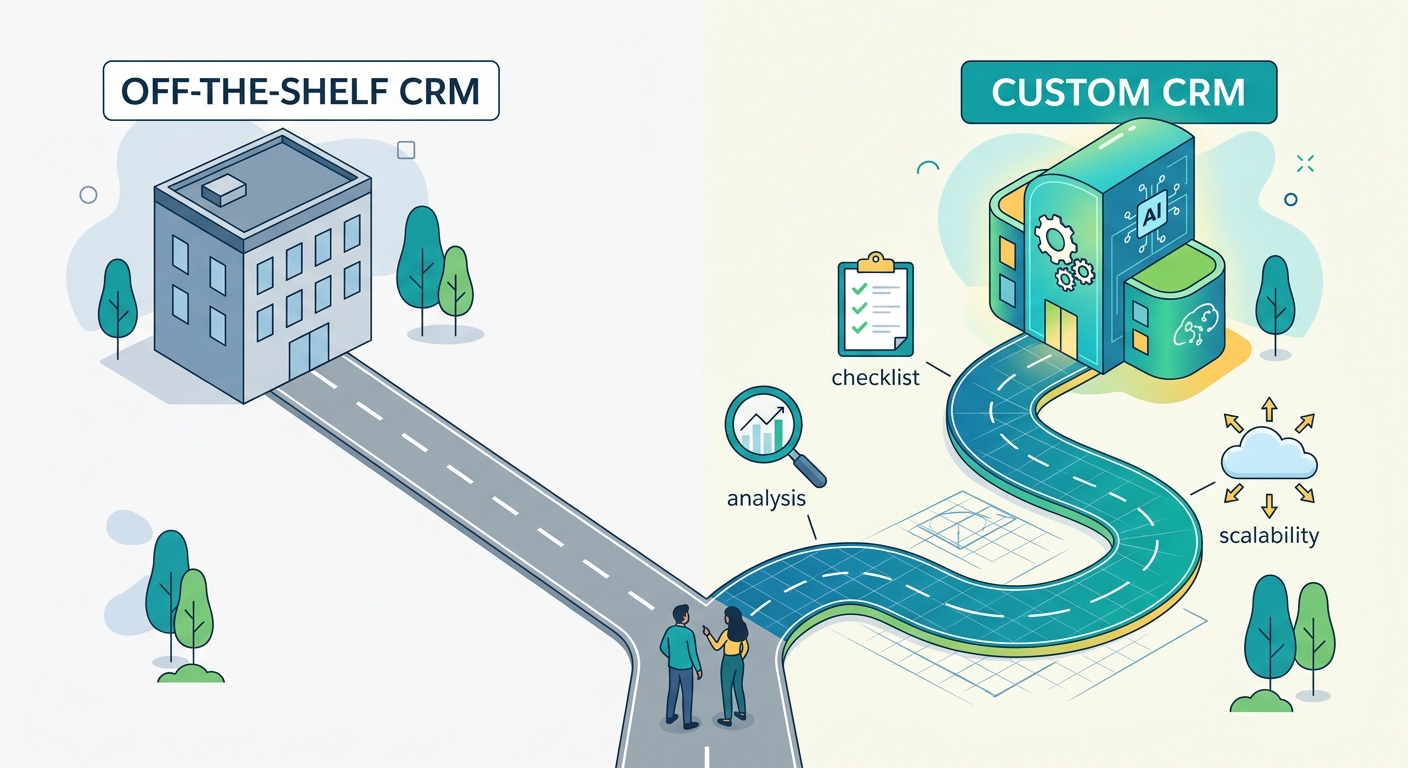
The CRM Dilemma: Tailored Fit or Ready-Made Solution?
In today’s competitive landscape, a robust Customer Relationship Management (CRM) system is no longer a luxury but a necessity. It’s the central nervous system for your sales, marketing, and customer service operations, designed to streamline interactions, manage leads, and foster lasting customer loyalty. However, choosing the right CRM solution often presents a significant challenge: should you opt for a ready-made, off-the-shelf platform, or invest in a custom-built system tailored to your unique business needs?

This decision, often framed as a simple ‘build vs buy CRM software’ choice, has profound implications for your operational efficiency, scalability, and long-term competitive advantage. Many businesses initially gravitate towards off-the-shelf options for their perceived ease and speed, only to encounter limitations as they grow and their processes evolve. Conversely, the idea of a custom CRM might seem daunting due to initial investment, but it can unlock unparalleled strategic benefits.
This article will delve into the critical factors you must consider when evaluating custom CRM vs off-the-shelf solutions, moving beyond generic pros and cons to provide a comprehensive decision-making framework. We’ll explore aspects like Total Cost of Ownership (TCO), unique business process alignment, AI integration, and intellectual property, ensuring you make an informed choice that truly empowers your business.
What is an Off-the-Shelf CRM?
An off-the-shelf CRM is a pre-built, standardized software solution that you can subscribe to and use immediately. Popular examples include Salesforce, HubSpot, Zoho CRM, and Microsoft Dynamics 365. These platforms are designed to serve a broad range of businesses across various industries, offering a standard set of features for contact management, sales pipeline tracking, marketing automation, and customer support.
Their primary appeal lies in rapid deployment, lower upfront costs (typically subscription-based), and readily available support and updates. They are ideal for businesses with standard operational workflows, smaller teams, or those just starting to formalize their customer management processes.
What is a Custom CRM?
A custom CRM, on the other hand, is a software system developed from the ground up to meet the precise, unique requirements of a specific business. Think of it as a bespoke suit, meticulously designed and tailored to fit your organization’s exact contours, rather than a mass-produced garment. This approach allows businesses to define every feature, workflow, integration, and user interface element, ensuring the system perfectly mirrors their operational processes and strategic goals.
Custom CRMs are particularly valuable for companies with highly specialized sales cycles, complex service delivery models, or those operating in niche markets where generic solutions fall short. They offer unparalleled flexibility, control, and the potential for significant competitive differentiation.
Custom CRM vs off-the-shelf: 7 Ultimate Factors to Decide
Navigating the choice between a custom-built and an off-the-shelf CRM requires a deep understanding of your business, its future aspirations, and the long-term implications of each option. Here are seven ultimate factors to guide your decision:
1. Business Process Alignment & Competitive Advantage
Off-the-shelf CRMs often force businesses to adapt their processes to the software’s predefined workflows. While this can be beneficial for standardization, it becomes a significant limitation for businesses with unique operational models that are core to their competitive edge. If your sales cycle, customer onboarding, or service delivery involves proprietary steps, specialized data capture, or intricate approval flows, an off-the-shelf solution will likely require cumbersome workarounds, external tools, or manual interventions, leading to inefficiencies and data silos.
A custom CRM, conversely, is built to perfectly align with your existing, optimized processes, enhancing rather than hindering them. This direct alignment is a key custom CRM benefit, allowing your team to operate at peak efficiency and leverage your unique methodologies for competitive advantage. For instance, a logistics company with a complex multi-leg delivery tracking system would find an off-the-shelf CRM inadequate for its specific operational nuances, whereas a custom solution could seamlessly integrate real-time tracking, driver management, and client communication into a single, cohesive platform.
2. Total Cost of Ownership (TCO): Beyond the Sticker Price
The ‘build vs buy CRM software’ debate often fixates on initial costs. Off-the-shelf CRMs typically have lower upfront costs, mainly comprising subscription fees. However, a deeper dive into the custom CRM total cost of ownership reveals a more nuanced picture.
- Off-the-Shelf TCO: Beyond subscriptions, consider costs for user licenses (which scale with your team), premium feature add-ons, third-party integrations, extensive customization (which can be costly and limited), training, and potential data migration fees. As your business grows, these recurring costs can escalate significantly, often without delivering a perfect fit.
- Custom CRM TCO: While initial development costs are higher, a custom solution can offer lower long-term TCO. You pay for exactly what you need, avoiding unnecessary features. Maintenance and support are tailored, and future enhancements are often more cost-effective as they build upon a known codebase. Importantly, a custom CRM eliminates recurring per-user license fees, which can lead to substantial savings over time, especially for growing organizations. Consider hosting costs (e.g., AWS, GCP, which Applizor specializes in), but these are often predictable and scalable.
Understanding these long-term financial implications is crucial for a strategic investment.
3. Scalability and Flexibility
Businesses evolve, and your CRM must evolve with you. Off-the-shelf solutions offer scalability within their predefined architecture. You can usually add more users, storage, or upgrade to higher-tier plans. However, their flexibility for fundamental changes or entirely new business models can be limited. If your core business strategy shifts, an off-the-shelf CRM might struggle to adapt, leading to significant off-the-shelf CRM limitations and potential vendor lock-in.
A custom CRM, built with a scalable architecture (like those developed by Applizor using modern tech stacks and cloud platforms such as AWS/GCP), offers unparalleled flexibility. It can be designed from day one to accommodate future growth, new product lines, international expansion, or entirely new business units. You have complete control over its evolution, ensuring it remains a strategic asset rather than a bottleneck.
4. Integration Capabilities
Your CRM rarely operates in isolation. It needs to seamlessly connect with your ERP, accounting software, marketing automation platforms, e-commerce systems, and other critical business tools. Off-the-shelf CRMs often provide a marketplace of pre-built integrations, but these can be limited in depth, expensive, or require significant configuration. Complex or niche integrations might not be available, necessitating custom API development or manual data transfers.
With a custom CRM, integration is a core design consideration. Applizor, for instance, specializes in developing custom APIs and robust integration layers, ensuring your CRM communicates flawlessly with all your existing and future systems. This creates a truly unified data ecosystem, eliminating data silos and enabling comprehensive reporting and automation across your entire tech stack.
5. Data Security, Compliance, and Intellectual Property
Data security and compliance (e.g., GDPR, HIPAA, local Indian regulations) are paramount. With an off-the-shelf CRM, you entrust your sensitive customer data to a third-party vendor. While reputable vendors have robust security measures, you are still bound by their policies and data handling practices. Compliance adherence becomes a shared responsibility, and you have less direct control over where and how your data is stored and processed.
A custom CRM offers superior control over data security and compliance. You define the security protocols, encryption standards, and data residency requirements. Furthermore, you own the intellectual property (IP) of the software. This is a critical advantage: the custom CRM itself becomes a proprietary asset, adding value to your business and providing a distinct competitive edge that cannot be replicated by competitors simply subscribing to the same off-the-shelf tool. Applizor ensures that all custom software development projects result in full IP ownership for the client.
6. Leveraging AI Automation & Advanced Features
The rise of AI presents unprecedented opportunities for enhancing CRM capabilities. Off-the-shelf CRMs are slowly integrating AI features, but these are often generic and limited to common use cases. For businesses seeking a true competitive advantage through intelligent automation, these generic features may not suffice.
A custom CRM, especially when built by an expert like Applizor, can integrate advanced AI automation directly into your unique workflows. Imagine:
- AI Agents: Automating lead qualification, customer service responses, or proactive outreach based on specific customer behavior patterns.
- n8n Workflow Automation: Designing intricate multi-step workflows that connect your CRM with other tools, trigger actions, and automate complex tasks without manual intervention. Learn more at n8n.io.
- RAG Knowledge Bases: Integrating Retrieval Augmented Generation (RAG) knowledge bases (Applizor’s AI KB) to provide sales and support teams with instant, context-aware information from your internal documents, improving response times and accuracy.
- Voice Bots: Integrating custom voice bots for initial customer interactions, appointment scheduling, or information gathering, directly feeding data into your CRM.
This level of tailored AI automation is virtually impossible with off-the-shelf solutions and represents a significant differentiator for businesses committed to innovation.
7. Implementation Time & Resource Commitment
Off-the-shelf CRMs generally boast faster implementation times, allowing businesses to get up and running quickly. However, this speed often comes at the cost of extensive configuration and training to adapt users to the system’s quirks. The initial ease can mask ongoing resource drain from workarounds and manual processes.
Custom CRM development requires a greater upfront time and resource commitment for discovery, design, development, and testing. However, this investment leads to a system that requires less ongoing adaptation, minimal workarounds, and often faster user adoption because it mirrors existing workflows. The long-term efficiency gains and strategic benefits often outweigh the initial longer implementation phase.
Decision-Making Framework: A Checklist for Your Business
To help you make the right choice, consider the following questions:
- Uniqueness of Processes: Do your core sales, marketing, or service processes provide a competitive advantage and deviate significantly from industry standards? (If Yes, lean Custom)
- Total Cost of Ownership (TCO): Have you calculated the 3-5 year TCO for both options, including licenses, add-ons, integrations, maintenance, and potential inefficiencies? (Consider Custom for long-term savings)
- Scalability & Future Growth: Do you anticipate significant shifts in your business model, rapid growth, or expansion into new areas that might strain a generic system? (If Yes, lean Custom)
- Integration Needs: Do you require deep, seamless, and potentially complex integrations with multiple existing or future internal systems? (If Yes, lean Custom)
- Data Security & Compliance: Are your data security and compliance requirements exceptionally stringent, or is IP ownership a strategic priority? (If Yes, lean Custom)
- AI & Automation Ambition: Do you plan to leverage advanced, tailored AI agents, workflow automation (like n8n), or RAG knowledge bases to drive efficiency and competitive edge? (If Yes, lean Custom)
- Resource Availability: Do you have the internal resources (time, budget, personnel) to invest in a strategic, long-term software development project? (If Yes, Custom is viable)
If you answered ‘Yes’ to three or more of these questions, a custom CRM solution is likely the more strategic and beneficial choice for your business.
Conclusion
The decision between a custom CRM vs off-the-shelf solution is not merely a technical one; it’s a strategic business decision that impacts your operational efficiency, competitive standing, and future growth trajectory. While off-the-shelf options offer speed and initial cost savings, they often come with limitations in customization, integration, and long-term flexibility. A custom CRM, though requiring a greater upfront investment, provides a perfectly aligned, scalable, secure, and future-proof platform that can truly differentiate your business.
At Applizor Softech LLP, we understand these complexities. With our expertise in custom software engineering, AI automation, and cloud solutions, we empower businesses to build CRM systems that are not just tools, but strategic assets designed for unparalleled performance and competitive advantage. Whether you’re a startup founder, an SME owner, or a CTO, making an informed choice now will define your customer relationship management success for years to come.