
Why Generic Inventory Software Falls Short for Small Retailers
Small retail businesses operate with unique characteristics. From niche product lines and specific supplier relationships to distinctive customer service models and local market demands, no two small stores are exactly alike. Yet, many turn to off-the-shelf inventory management software, hoping for a one-size-fits-all solution.

While generic solutions can offer basic tracking, they often fall short in critical areas:
- Rigid Workflows: Off-the-shelf systems impose predefined processes that may not align with your existing, often efficient, operational flow. This forces businesses to adapt to the software, rather than the software adapting to them, leading to inefficiencies and frustration.
- Integration Headaches: Small retailers often use a patchwork of tools – a local POS system, an e-commerce platform (like WooCommerce), and separate accounting software (perhaps for GST billing). Generic inventory software frequently struggles with seamless, real-time integration across these disparate systems, resulting in manual data entry, errors, and outdated information.
- Limited Scalability & Features: As your business grows, generic solutions can become restrictive. Adding new sales channels, expanding product categories, or implementing complex pricing strategies might require expensive upgrades or force you to switch systems entirely, disrupting operations and incurring significant costs.
- Lack of Unique Insights: Standard reports provide generic data. They rarely offer the deep, tailored insights needed to understand your specific customer buying patterns, optimize unique product assortments, or identify store-specific trends.
This is where the power of a custom software solution truly shines.
What is Custom Inventory Management?
Custom inventory management refers to a software system meticulously designed and developed to meet the precise, unique needs and operational workflows of a specific retail business. Unlike generic software, which offers a broad set of features for a wide audience, a custom system is built from the ground up to address your exact challenges and leverage your specific advantages.
It’s about creating a bespoke inventory system for retailers, ensuring that every function, every report, and every integration serves your business objectives directly. This tailored stock management for small stores transforms inventory from a logistical burden into a strategic asset, providing unparalleled control, efficiency, and adaptability.
7 Proven Solutions for Small Retailers with Custom Inventory Management
Embracing a custom approach allows small retailers to implement highly effective, tailored solutions. Here are seven ways custom inventory management can revolutionize your operations:
1. Tailored Workflow Automation
A custom system can mirror your exact receiving, stocking, picking, and shipping processes. If you have a unique way of categorizing products, handling returns, or managing seasonal stock, the software is built to automate these specific workflows. This eliminates manual workarounds, reduces errors, and significantly boosts operational efficiency.
2. Seamless Integration Hub
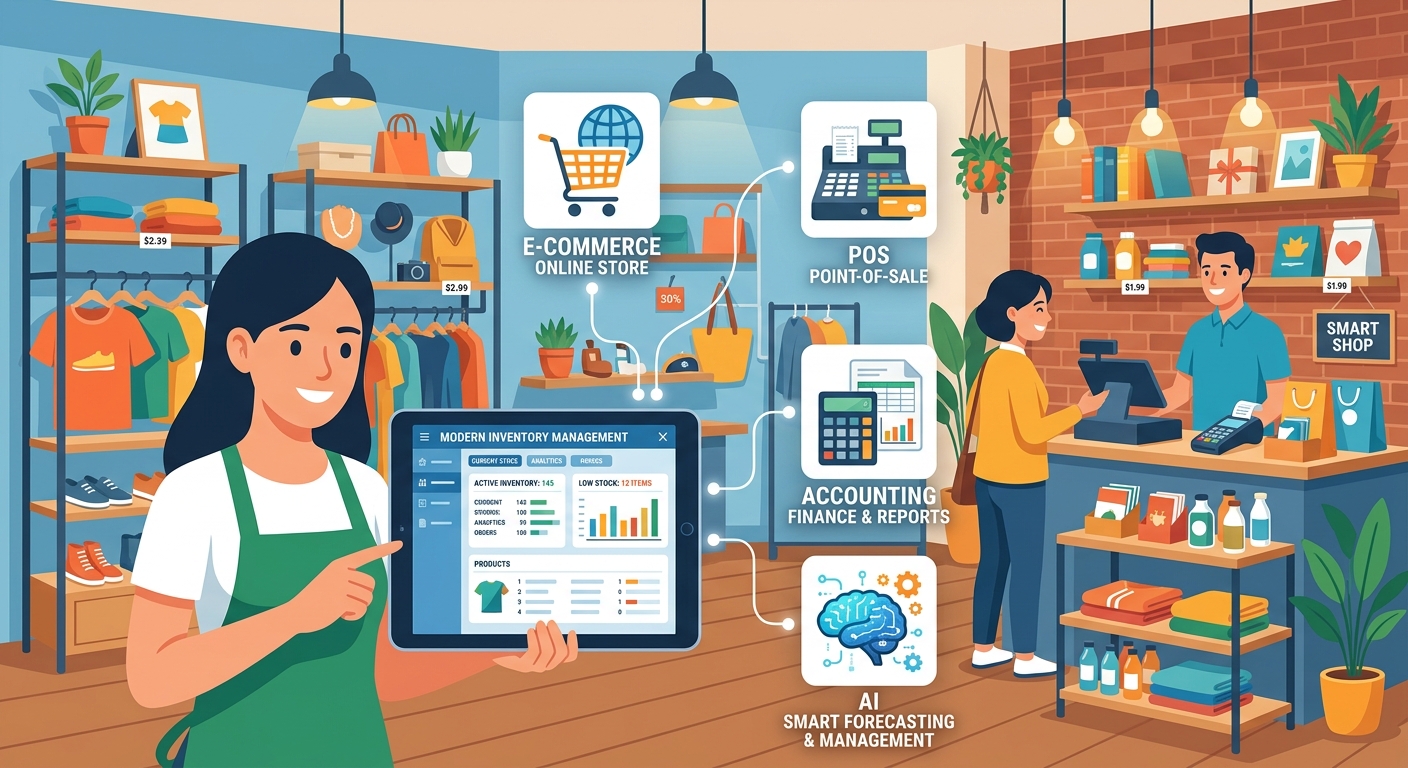
One of the most significant advantages of custom inventory software is its ability to integrate flawlessly with your existing ecosystem. This includes your Point of Sale (POS) system, e-commerce platforms (like WordPress with WooCommerce), accounting software (especially crucial for GST billing in India), and even supplier portals. Real-time data synchronization across all channels ensures accurate stock levels everywhere, preventing overselling and improving customer satisfaction.
3. AI-Powered Demand Forecasting & Reordering
Leverage the power of AI automation to predict future demand with greater accuracy. A custom inventory system can incorporate AI models that analyze historical sales data, seasonal trends, promotions, and even external factors to forecast demand. This enables automated reordering triggers, optimizing stock levels, minimizing carrying costs, and drastically reducing stockouts. Imagine a system that learns your business’s rhythm and proactively ensures you always have the right products at the right time.
4. Real-time Multi-Channel Stock Synchronization
For retailers selling both in-store and online, maintaining accurate, real-time inventory across all channels is paramount. A bespoke inventory system for retailers ensures that when an item sells online, it’s immediately updated in your physical store’s available stock, and vice-versa. This eliminates discrepancies, enhances the customer experience, and supports omnichannel strategies.
5. Scalable Architecture for Growth
Unlike subscription-based products with rigid feature sets, a custom solution is built with your future growth in mind. Whether you plan to open new locations, expand into new product categories, or add more complex fulfillment options, the underlying architecture can be designed to scale effortlessly. This future-proofs your investment, ensuring your inventory system evolves with your business without requiring a complete overhaul.
6. Optimized Reporting & Analytics
Gain deep, actionable insights tailored to your business. Custom inventory management allows you to define exactly what data you need to track and how you want it presented. Generate reports on slow-moving items, best-sellers by specific attributes, supplier performance, profit margins per product line, or inventory turnover rates – all customized to help you make informed strategic decisions.
7. Enhanced Supplier & Vendor Management
Streamline your procurement process with integrated supplier management. A custom system can track vendor performance, automate purchase order generation based on reorder points, manage lead times, and even facilitate direct communication or data exchange with key suppliers. This leads to better relationships, optimized purchasing, and reduced administrative overhead.
Custom vs. Off-the-Shelf: A Long-Term Cost-Benefit Analysis
The initial investment for custom software development is often higher than a monthly subscription for generic software. However, it’s crucial to look beyond the upfront cost and consider the Total Cost of Ownership (TCO) and long-term Return on Investment (ROI).
- Initial Investment vs. TCO: While generic software has lower monthly fees, hidden costs often accumulate. These include fees for additional features, integrations, user licenses, and the significant operational costs of manual workarounds, errors, and lost sales due to system limitations. Custom software, though pricier initially, eliminates these ongoing inefficiencies.
- ROI from Efficiency: A tailored system dramatically reduces manual tasks, minimizes stockouts and overstocking, and optimizes order fulfillment. These efficiencies translate directly into saved labor costs, reduced waste, and increased sales, offering a substantial ROI over time.
- Strategic Advantage: A custom inventory system provides a competitive edge. By precisely meeting your unique needs, it enables faster decision-making, better customer service, and the agility to adapt to market changes – capabilities that generic solutions simply cannot offer.
- Future-Proofing: The scalability and adaptability of custom software mean you won’t need to replace your system every few years as your business evolves, saving immense costs and disruption in the long run.
For many small retailers, the long-term operational efficiency, strategic advantages, and future-proofing benefits of custom inventory management far outweigh the initial investment, making it a truly smart financial decision.
Partnering for Your Bespoke Inventory Solution
Developing a custom inventory management system requires expertise in software engineering, UI/UX design, database management, and potentially AI integration. Partnering with an experienced technology provider like Applizor Softech LLP ensures that your solution is robust, secure, and perfectly aligned with your business goals.
With our expertise in custom ERP/SaaS development, AI automation (including n8n workflow automation and AI agents), and web and mobile app development (Flutter, React Native), we can craft a bespoke inventory system that not only solves your current challenges but also empowers your retail business for sustainable growth. From integrating with your existing retail/POS billing and GST billing systems to incorporating advanced demand forecasting, we build solutions that truly work for you.
Conclusion
For small retailers aiming for efficiency, scalability, and a competitive edge, generic inventory software often proves to be a limiting factor. Embracing custom inventory management offers a powerful alternative, providing solutions precisely engineered for your unique operational DNA. By integrating seamlessly with existing systems, leveraging AI for intelligent automation, and offering unparalleled flexibility for future growth, a bespoke inventory system transforms how you manage stock, ultimately driving profitability and paving the way for sustained success.