
Understanding Custom Software Development Costs: The Core Challenge for SMEs
For startup founders, SME owners, and IT leaders, the question of custom software development costs often feels like searching for a moving target. Unlike off-the-shelf solutions with clear price tags, bespoke software is tailored to your unique business processes, making a precise upfront estimate complex. Yet, understanding the underlying factors that drive these costs is crucial for effective budgeting, strategic planning, and ultimately, achieving a strong return on investment.
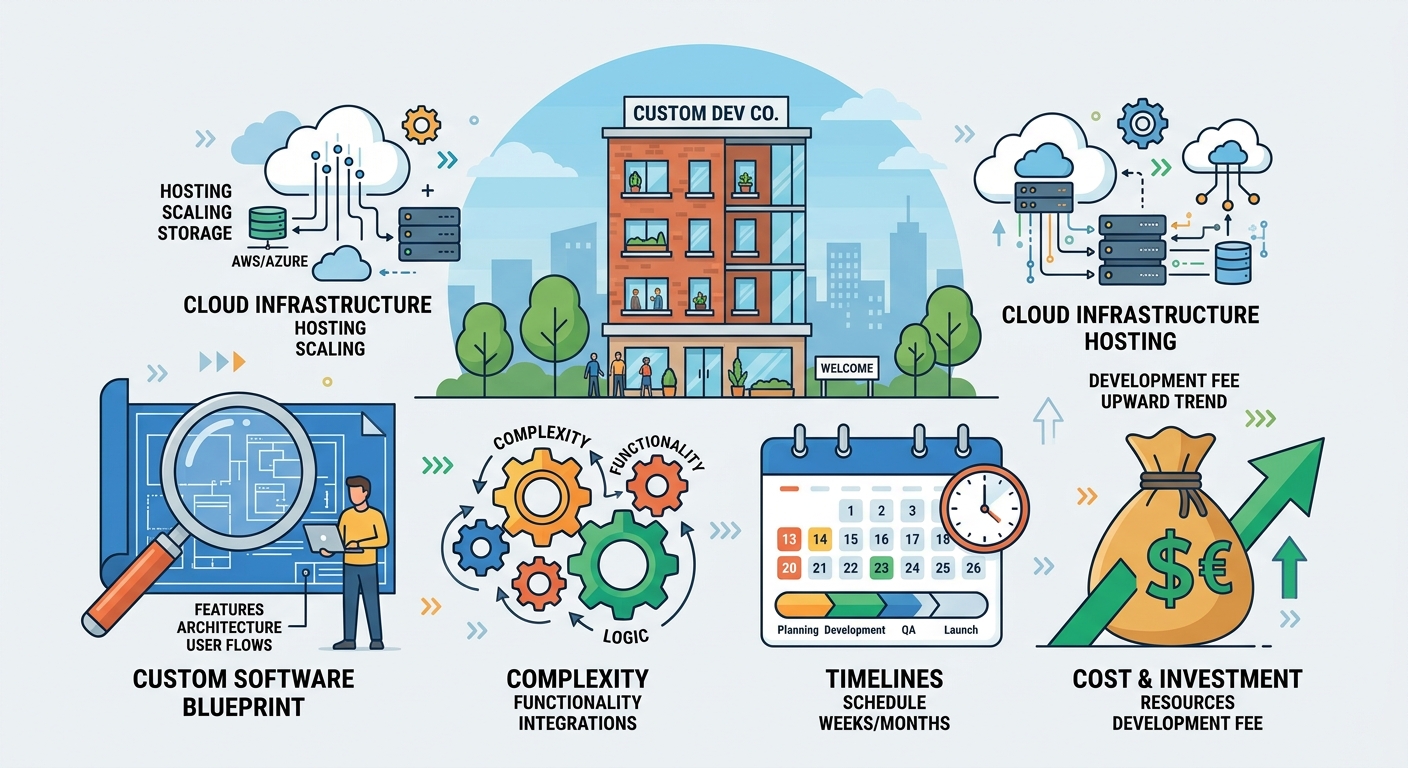
This article breaks down the 7 ultimate factors that significantly influence how much your custom software project will cost. We’ll also delve into specific cost considerations for various software types relevant to small and medium-sized enterprises (SMEs), offer actionable strategies to optimize your budget, and explore the long-term financial perspective, including the value proposition of developing custom software in India.
Build vs. Buy: A Cost-Benefit Lens for Small Businesses
Before diving into the factors, many SMEs grapple with the fundamental choice: build custom software or buy an existing solution? While off-the-shelf software (SaaS) offers immediate availability and lower upfront costs, it often comes with limitations. You might pay for features you don’t need, struggle with integrations, or find your unique workflows don’t fit the rigid structure.
Custom software, on the other hand, is built precisely for your needs. It promises perfect alignment with your operations, scalability, and competitive advantage. However, it requires a higher initial investment and a longer development cycle. From a cost perspective, the ‘build vs. buy’ decision hinges on:
- Upfront vs. Long-Term Costs: SaaS involves recurring subscriptions that accumulate over time. Custom software has a higher initial cost but eliminates ongoing subscription fees for the core system.
- Customization Needs: If your business processes are highly specialized, the cost of customizing an off-the-shelf solution (or living with its limitations) might quickly outweigh the initial custom development investment.
- Scalability and Future-Proofing: Custom software can be designed to scale with your growth and integrate new technologies without vendor lock-in, potentially saving significant costs in the long run.
- Data Ownership and Security: Custom solutions often offer greater control over your data and security protocols, which can be invaluable for compliance and peace of mind.
7 Ultimate Factors Influencing Custom Software Development Costs
No two custom software projects are identical, and their costs reflect this uniqueness. Here are the primary factors that will shape your investment:
1. Project Scope and Complexity
This is arguably the most significant cost driver. The more features, functionalities, and intricate logic your software requires, the more time and resources it will consume. Consider:
- Number of Features: Each distinct function (e.g., user login, reporting, payment processing, inventory tracking) adds to development effort.
- User Roles and Permissions: A system with multiple user types (e.g., admin, manager, employee, customer) each with different access levels, is far more complex than a single-user application.
- Third-Party Integrations: Connecting your custom software to external services like payment gateways, CRM systems, accounting software, or SMS/email APIs significantly increases complexity. Tools like n8n workflow automation can streamline these integrations, but the initial setup and testing still contribute to costs.
- Data Migration: If you need to transfer existing data from old systems, this adds a layer of complexity and cost.
For instance, a simple internal tool for managing team tasks will cost considerably less than a comprehensive custom ERP system with multiple modules, real-time analytics, and integrations with supplier portals.
2. Technology Stack and Architecture
The choice of programming languages, frameworks, databases, and cloud infrastructure directly impacts development time and expertise required.
- Frontend Technologies: Are you building a web app using React or Angular? A mobile app with React Native or Flutter for cross-platform reach, or native iOS/Android for specific performance needs?
- Backend Technologies: The complexity of your server-side logic, API development, and database management (e.g., SQL, NoSQL) influences costs.
- Cloud Infrastructure: Hosting on platforms like AWS or Google Cloud Platform (GCP) involves configuration, management, and ongoing costs. The more robust and scalable your infrastructure needs to be, the higher the setup and maintenance efforts.
- Specialized Technologies: Incorporating advanced features like machine learning models, real-time data processing, or blockchain can require specialized skills, leading to higher rates.
3. Team Size and Expertise
The number of professionals involved and their experience levels directly correlate with costs. A typical development team includes:
- Project Manager: Oversees the entire project, ensuring timelines and budget are met.
- Business Analyst: Gathers and refines requirements.
- UI/UX Designers: Create intuitive and engaging user interfaces.
- Frontend Developers: Build the user-facing parts of the application.
- Backend Developers: Develop server-side logic, databases, and APIs.
- Quality Assurance (QA) Engineers: Test the software for bugs and performance issues.
- DevOps Engineers: Manage infrastructure, deployment, and continuous integration/delivery (CI/CD).
Highly experienced developers command higher rates, but their efficiency and ability to foresee challenges can often lead to faster development and fewer costly revisions in the long run.
4. Development Methodology and Iterations
The chosen development approach impacts cost and timeline.
- Agile vs. Waterfall: Agile methodologies, with their iterative cycles and continuous feedback, can be more flexible and allow for course correction, potentially reducing the risk of building the wrong features. Waterfall is more rigid but can be suitable for projects with extremely well-defined, unchanging requirements.
- Minimum Viable Product (MVP): Starting with an MVP—a version of your software with just enough features to be usable by early customers—is an excellent strategy for SMEs. It allows you to test market viability, gather feedback, and secure further funding with a lower initial investment, reducing overall custom software development costs.
- Phased Development: Breaking a large project into smaller, manageable phases allows for better budget control and continuous delivery of value.
5. UI/UX Design and Branding
A well-designed user interface (UI) and user experience (UX) are critical for user adoption and satisfaction. The effort involved varies:
- Custom Design: A completely bespoke design tailored to your brand identity and user needs will cost more than using pre-built templates or standard UI components.
- Complexity of User Flows: Applications with intricate user journeys, multiple dashboards, and complex data visualizations require more extensive design work.
- Interactive Elements: Animations, custom graphics, and highly interactive components add to design and development time.
6. Testing, Quality Assurance, and Security
Robust testing and security measures are non-negotiable for reliable software, and they come with a cost.
- Types of Testing: Unit testing, integration testing, system testing, user acceptance testing (UAT), and performance testing all require dedicated effort.
- Automation: Automated testing frameworks can save time in the long run but require initial setup investment.
- Security Audits: For applications handling sensitive data (e.g., financial, medical), security audits and penetration testing are crucial for compliance and protecting your business and users.
- Compliance Requirements: Adhering to industry-specific regulations (e.g., GDPR, HIPAA, local Indian laws) adds significant development and testing overhead.
7. Post-Launch Support, Maintenance, and Hosting
The initial development cost is just one part of the equation. Long-term ownership involves ongoing expenses:
- Bug Fixes and Updates: Software requires continuous maintenance to fix bugs, adapt to new operating systems or browser versions, and patch security vulnerabilities.
- Feature Enhancements: As your business evolves, you’ll likely want to add new features or improve existing ones.
- Hosting and Infrastructure: Ongoing costs for cloud hosting (AWS, GCP), server management, and database services.
- DevOps and Monitoring: Continuous integration, continuous deployment (CI/CD) pipelines, and system monitoring ensure your application remains stable and performs optimally.
Custom Software Development Costs by Type: What SMEs Can Expect
To provide a more concrete perspective, let’s look at cost considerations for specific types of custom software Applizor Softech LLP specializes in:
Custom ERP/CRM/SaaS Solutions
Building a custom Enterprise Resource Planning (ERP), Customer Relationship Management (CRM), or a bespoke Software as a Service (SaaS) platform is a significant undertaking. Costs can range widely based on the number of modules (e.g., inventory, sales, HR, finance), complexity of business logic, user roles, and integrations. A basic custom CRM for a small team might start at a moderate investment, while a comprehensive custom ERP solution like Applizor ERP or Company OS, designed for deep integration across all business functions, represents a substantial strategic investment.
Mobile Applications (Flutter, React Native, Native)
Mobile app development costs depend heavily on platform choice, features, and backend complexity. Cross-platform frameworks like Flutter and React Native can reduce costs by using a single codebase for iOS and Android, but may not be ideal for highly complex, performance-critical apps requiring native development. Features like GPS integration, camera access, push notifications, offline capabilities, and complex animations all add to the development effort.
AI Automation & Voice Bots
Developing AI agents, RAG (Retrieval Augmented Generation) knowledge bases, or voice bots involves unique cost factors. These include data collection and preparation, model training, algorithm complexity, integration with existing systems, and natural language processing (NLP) capabilities. A simple AI chatbot for customer support might be less costly than a complex AI automation solution that analyzes large datasets to predict market trends or automate sophisticated workflows using tools like n8n.
WordPress/WooCommerce Websites
While WordPress itself is open-source, custom development costs arise from bespoke theme design, custom plugin development to add unique functionalities (e.g., unique booking systems, advanced product configurators), complex integrations with third-party services, and e-commerce features for WooCommerce. A simple brochure website will be far less expensive than a highly customized, high-traffic WooCommerce store with advanced inventory management and personalized customer experiences.
Optimizing Your Budget: Strategies to Reduce Custom Software Development Costs for SMEs
While custom software development costs can seem daunting, SMEs have several actionable strategies to control and optimize their budget:
- Define Requirements Clearly: Ambiguity is a budget killer. Invest time upfront in defining precise, detailed requirements. Use user stories, wireframes, and flowcharts to communicate your vision clearly to the development team.
- Start with an MVP: Focus on the absolute core functionality that solves your most pressing problem. Launching an MVP allows you to gather real-world feedback, validate your concept, and iterate based on user needs, rather than overbuilding features that may not be used.
- Prioritize Features Ruthlessly: Categorize features as ‘must-have,’ ‘should-have,’ and ‘nice-to-have.’ Develop ‘must-haves’ first, then consider ‘should-haves’ in subsequent phases. This prevents scope creep and keeps initial costs down.
- Opt for Phased Development: Break down large projects into smaller, manageable phases. This allows for better budget allocation, continuous delivery of value, and the flexibility to adjust future phases based on early results.
- Leverage Existing Tools and APIs: Instead of building every component from scratch, explore integrating robust third-party APIs for common functionalities like payment processing, SMS notifications, or analytics. This can significantly reduce development time and cost.
- Choose the Right Development Partner: A transparent and experienced partner will provide realistic estimates, communicate openly about potential challenges, and help you make cost-effective decisions without compromising quality.
The India Advantage: Value in Custom Software Development
For international and Indian SMEs looking to reduce custom software development costs without sacrificing quality, partnering with a company based in India offers a compelling value proposition.
- Cost-Effectiveness: India’s competitive talent pool and lower operational costs translate into more affordable development rates compared to many Western countries, often allowing SMEs to achieve more within their budget.
- Skilled Talent Pool: India boasts a vast pool of highly skilled and experienced software engineers proficient in a wide range of technologies, from full-stack development to AI and cloud computing.
- Quality and Innovation: Indian developers are known for their technical expertise, problem-solving abilities, and commitment to delivering high-quality, innovative solutions.
- Time Zone Benefits: For clients in Europe or North America, the time difference can facilitate a ‘follow-the-sun’ development model, potentially speeding up project timelines.
Beyond the Initial Price Tag: Long-Term ROI and Hidden Costs
When evaluating custom software, it’s crucial to look beyond the initial development cost to understand the total cost of ownership and the long-term return on investment (ROI).
- Operational Efficiency: Custom software designed to automate specific workflows can dramatically improve operational efficiency, reduce manual errors, and free up staff for more strategic tasks. This translates into significant long-term savings.
- Competitive Advantage: Unique software can differentiate your business, enable new services, or provide insights that competitors lack.
- Scalability: Custom solutions can be built to scale with your business growth, avoiding the need for costly migrations or replacements later.
- Data Ownership and Insights: Owning your software means full control over your data, enabling deeper analytics and strategic decision-making.
- Hidden Costs: Remember to budget for ongoing maintenance (bug fixes, security patches), software updates (to support new OS versions or frameworks), cloud hosting fees (AWS, GCP), and potential future feature enhancements. A reliable development partner will help you understand and plan for these long-term expenses.
Conclusion
Custom software development costs are not a fixed number but rather a dynamic outcome of various interconnected factors. For SMEs, understanding these elements—from project scope and technology choices to team expertise and post-launch support—is key to making informed decisions.
By strategically defining your requirements, prioritizing an MVP approach, and choosing a knowledgeable development partner, you can optimize your budget and unlock the immense value that tailored software brings. Investing in custom software is an investment in your business’s future, enabling unparalleled efficiency, scalability, and a distinct competitive edge.